Porisma
Back to reading

Complex numbers and the Argand plane

Read complex numbers in the plane · Diagrams · Complete reading

Choose another diagram

The source circuit motivation

Expand diagram

Use the scrollbars or arrow keys to inspect details.
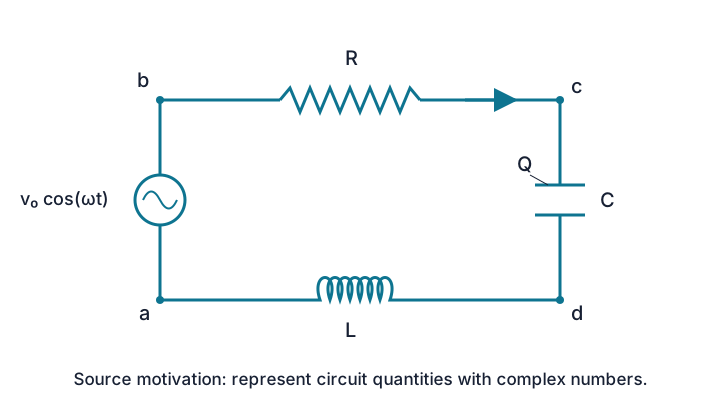
Source circuit motivation: rectangular loop a–b–c–d–a, alternating voltage source v0 cos(omega t) on ab, resistor R on bc with a rightward current arrow, capacitor C on cd with charge Q marked, and inductor L on da. This preserves the source component roles without posing a new circuit calculation.
Open original diagram (new tab)

The nested number sets

Read from the smallest set to the largest. Every number in one row also belongs to every row below it. Each next set includes additional numbers.

  1. Natural numbers

    Counting numbers 1,2,3,…1,2,3,\ldots. This source starts at 1, so zero is not included in N\mathbb N here.

  2. Integers

    The counting numbers, their negatives and zero: …,−1,0,1,…\ldots,-1,0,1,\ldots.

  3. Rational numbers

    Numbers p/qp/q, where p and q are integers and q≠0q\ne0. Every integer n is rational because n=n/1n=n/1.

  4. Real numbers

    Rational and irrational numbers together. Irrationals such as 2\sqrt2, π\pi and ee are real but not rational; their decimal representations neither terminate nor recur.

  5. Complex numbers

    Numbers a+iba+ib, with a and b real and i2=−1i^2=-1. Every real a is also complex: a=a+0ia=a+0i. A complex number need not have a nonzero imaginary part.

Why is each inclusion strict?

A proper subset is contained in a larger set without being equal to it. These examples show what each larger set adds.

  • Natural numbers are a proper subset of integers

    N⊊Z\mathbb N\subsetneq \mathbb Z

    00 — Zero is an integer, but it is not natural under this source’s convention.

  • Integers are a proper subset of rational numbers

    Z⊊Q\mathbb Z\subsetneq \mathbb Q

    12\tfrac12 — One half is rational, but it is not an integer.

  • Rational numbers are a proper subset of real numbers

    Q⊊R\mathbb Q\subsetneq \mathbb R

    2\sqrt2 — The positive square root of 2 is real and irrational, so it is not rational.

  • Real numbers are a proper subset of complex numbers

    R⊊C\mathbb R\subsetneq \mathbb C

    ii — The imaginary unit is complex but not real: no real number has square −1.

Compare with the nested regions

Expand diagram

Use the scrollbars or arrow keys to inspect details.
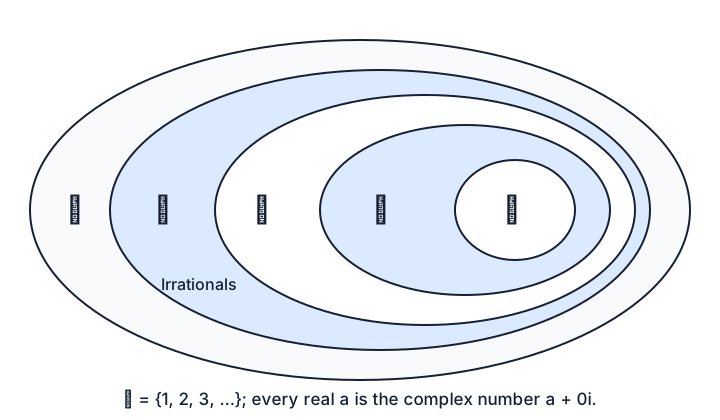
Nested regions show N strictly inside Z, Z inside Q, Q inside R, and R inside C. The real region outside Q represents irrational numbers. This source uses natural numbers starting at 1; every real a is complex as a+0i.
Open original diagram (new tab)

Point, position vector and direction in the Argand plane

Illustration: one complex number as a point and a position vector.

z = 1 + 3i

Grid spacing is 1 unit. P = (1, 3). The arrow OP has components (1, 3); its length is |z|.

Real coordinate x1
Imaginary coordinate y3
Try an example

z=x+iyz=x+iy

OP→=(xy)\overrightarrow{OP}=\begin{pmatrix}x\\y\end{pmatrix}

Real part x
1
Imaginary part y
3
Modulus |z|
≈ 3.1623
Principal argument θ
≈ 1.249 rad

The imaginary part is the real number y, not iy. A point and its position vector describe the same two coordinates.

Directions use −π < θ ≤ π, measured from the positive real axis. Anticlockwise is positive; clockwise is negative.

Compare with the three source views

Expand diagram

Use the scrollbars or arrow keys to inspect details.
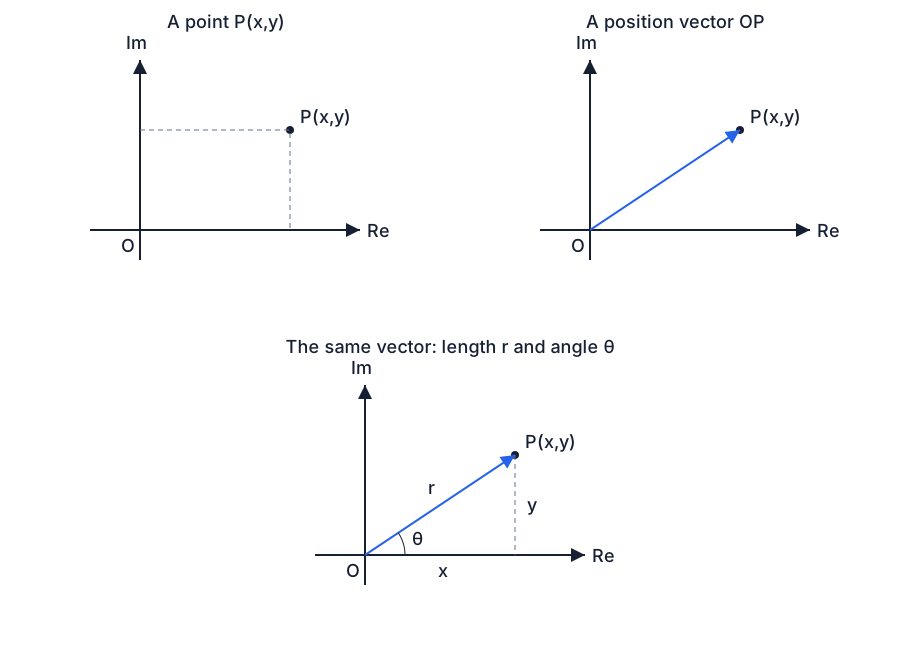
Three source views use the same first-quadrant point P(x,y). First shows dashed real/imaginary projections, second shows position vector OP, third labels its length r, its angle theta from the positive real axis and the x/y components. All axes are labelled Re and Im.
Open original diagram (new tab)
Back to reading