Complex numbers and the Argand plane
Measure modulus and argument · Diagrams
Method map: Choose a principal argument
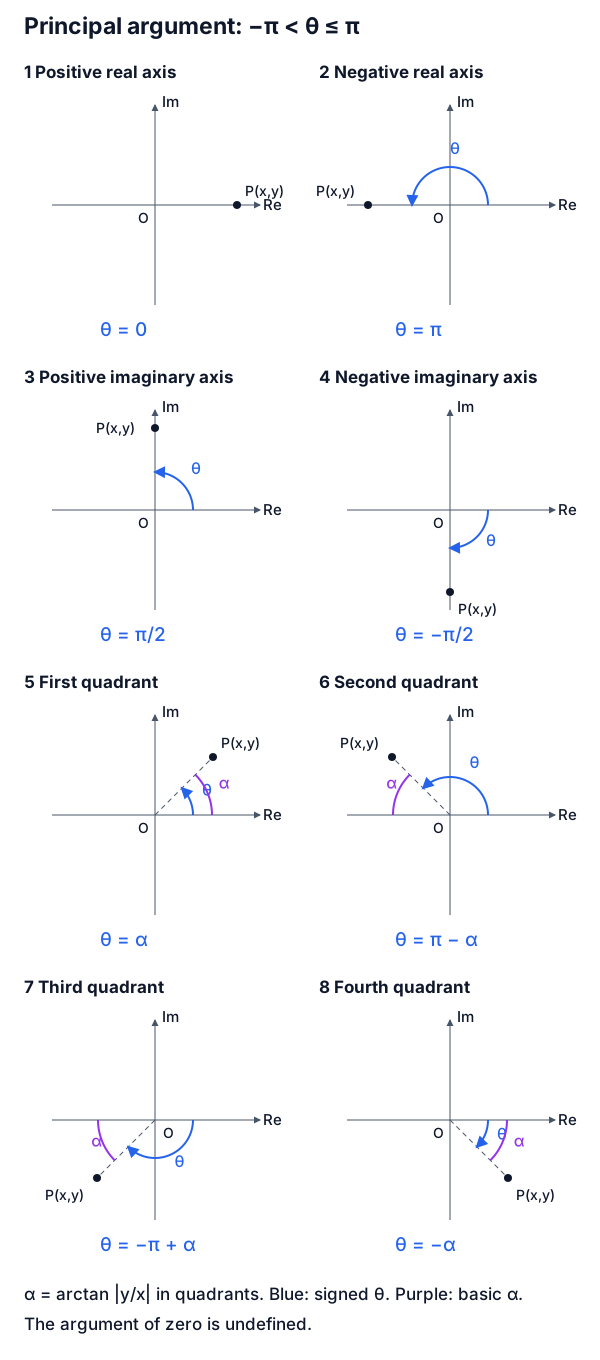
Plot z = x + iy. Check zero, then choose its axis or quadrant. Measure from the positive real axis: anticlockwise is positive; clockwise is negative.
Check that the point has a direction
Write z = x + iy with real x and y. The principal interval here includes π and excludes −π.
- x = 0 and y = 0Stop: zero has no argument
The zero vector has no direction. Its modulus is , but an argument is undefined; cannot supply an angle.
- At least one coordinate is nonzeroChoose the matching position case
If either coordinate is zero, use the axis cases. If both are nonzero, use the quadrant cases. A zero real part does not make the argument undefined when the imaginary part is nonzero.
Keep this interval throughout the calculation. The two directions π and −π reach the same negative real ray, but only π belongs to the chosen principal interval.
Read axis directions directly
Use this stage only for a nonzero point on an axis. One coordinate is zero, so an acute reference triangle is unnecessary.
or
- Positive real · x > 0, y = 0No turn
- Negative real · x < 0, y = 0Half a turn anticlockwise
Use , not the excluded endpoint .
- Positive imaginary · x = 0, y > 0Quarter turn anticlockwise
- Negative imaginary · x = 0, y < 0Quarter turn clockwise
Do not divide by x for a point on the imaginary axis. Its direction is read geometrically even though y/x is undefined.
Use the basic angle and both coordinate signs
Use this stage only when both coordinates are nonzero. Calculate the positive acute basic angle α in radians, then match the quadrant.
- I · x > 0, y > 0Use the basic angle
- II · x < 0, y > 0Subtract from π
- III · x < 0, y < 0Start at −π and add the basic angle
- IV · x > 0, y < 0Use the negative basic angle
The ratio alone cannot distinguish opposite quadrants. Check both signs on the sketch and confirm . Other arguments differ by for an integer k; select the representative in the stated interval.
Try a worked example
Read a case, make a prediction, then reveal the reasoning. The examples keep their stated values.
A negative real number uses the included endpoint
In Example 15(b), . Find its modulus and choose its principal argument.
Show reasoning
1. Locate the nonzero point
The point (−3, 0) is on the negative real axis. It is not the origin, so it has a direction.
2. Separate distance from direction
The squared coordinates sum to 9, so the distance is 3. The principal direction uses the included endpoint π.
3. Check the endpoint
A clockwise half-turn gives −π, which reaches the same ray but is excluded from this principal interval. A zero imaginary part does not imply zero argument.
Equal negative coordinates do not give a first-quadrant angle
In Example 15(h), . Find its modulus and choose its principal argument.
Show reasoning
1. Use both signs before the quotient
The point (−1, −1) lies in quadrant III. Its y/x ratio is positive, just as in quadrant I, so the quotient alone cannot select the direction.
2. Calculate the acute basic angle
The absolute ratio gives the acute angle to the nearest horizontal ray, not the final principal argument.
3. Choose the clockwise principal direction
Quadrant III requires a negative angle in the chosen interval. The positive turn 5π/4 reaches the same ray but is outside it.
Compare with the eight Argand positions
Expand diagramFit diagram to page
Use the scrollbars or arrow keys to inspect details.