Porisma
Back to reading

Complex numbers and the Argand plane

Use square roots and conjugates · Diagrams

Conjugation reflects in the real axis

Start with the source pair 1 + 3i and 1 − 3i, then change the coordinates.

z = 1 + 3i; z* = 1 − 3i

Grid spacing is 1 unit. Reflection pairs (1, 3) with (1, -3). The two distances from the origin are equal.

Real coordinate x1
Imaginary coordinate y3
Try an example

z∗=x−iyz^*=x-iy

∣z∣=x2+y2|z|=\sqrt{x^2+y^2}

Real part x
1
Imaginary part y
3
Common modulus |z| = |z*|
≈ 3.1623
Principal argument θ
≈ 1.249 rad
Conjugate z*
1 − 3i
Principal argument of z*
≈ -1.249 rad

Conjugation keeps the real part and changes the sign of the imaginary part. It reflects the point in the real axis.

Directions use −π < θ ≤ π, measured from the positive real axis. Anticlockwise is positive; clockwise is negative.

Compare with the source reflection

Expand diagram

Use the scrollbars or arrow keys to inspect details.
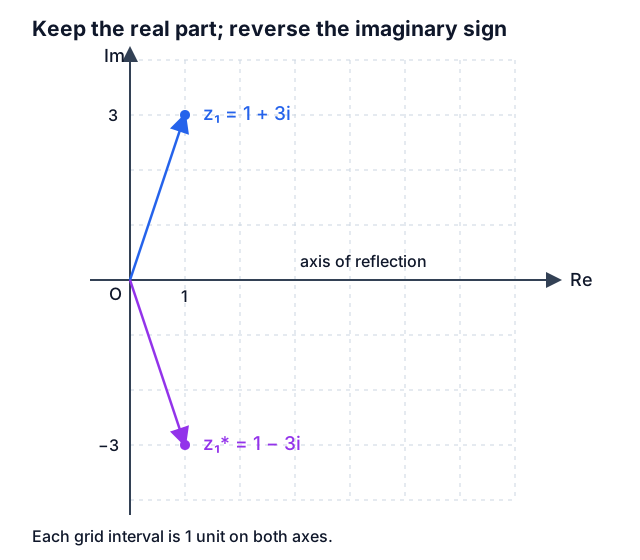
Equal-unit Argand axes show vectors from O to z1=(1,3) and its conjugate z1*=(1,-3), with dashed grid and equal distances above and below the real axis. The real coordinate remains 1; the imaginary coordinate changes from 3 to -3.
Open original diagram (new tab)
Back to reading