Porisma

Worked solution

Two functions, two different conclusions

Determine the range of each of the following functions. State, with reasons, whether the inverse function exists in each case. Then, find the rule and domain of the inverse function if it exists.

(a) h:x↦cos⁡(x+1)h:x\mapsto\cos(x+1), −1≤x≤−1+π2-1\leq x\leq-1+\frac{\pi}{2}.

(b) q:x↦ex(x−1)q:x\mapsto e^x(x-1), x∈Rx\in\mathbb R.

CJC · Functions · Discussion 1 · 2025

Answer

(a) Rh=[0,1]R_h=[0,1]; h−1(x)=cos⁡−1x−1h^{-1}(x)=\cos^{-1}x-1, 0≤x≤10\leq x\leq1. (b) Rq=[−1,∞)R_q=[-1,\infty); no inverse on the given domain.

Compare your reasoning

(a) On the allowed domain, 0≤x+1≤π/20\leq x+1\leq\pi/2, so cosine decreases strictly from 1 to 0. Thus Rh=[0,1]R_h=[0,1] and hh is one-to-one. From y=cos⁡(x+1)y=\cos(x+1), obtain x=arccos⁡(y)−1x=\arccos(y)-1. Therefore h−1(x)=arccos⁡(x)−1h^{-1}(x)=\arccos(x)-1, with domain [0,1][0,1] and range [−1,−1+π/2][-1,-1+\pi/2].

(b) q′(x)=xexq'(x)=xe^x: the function decreases for x<0x<0 and increases for x>0x>0, with minimum q(0)=−1q(0)=-1. It is continuous and unbounded above, so Rq=[−1,∞)R_q=[-1,\infty). A horizontal line at y=−1/2y=-1/2 intersects both branches. Hence qq is not one-to-one and has no inverse function on its given domain.

How did this question go?

Compare your sketch

Expand diagram

Use the scrollbars or arrow keys to inspect details.
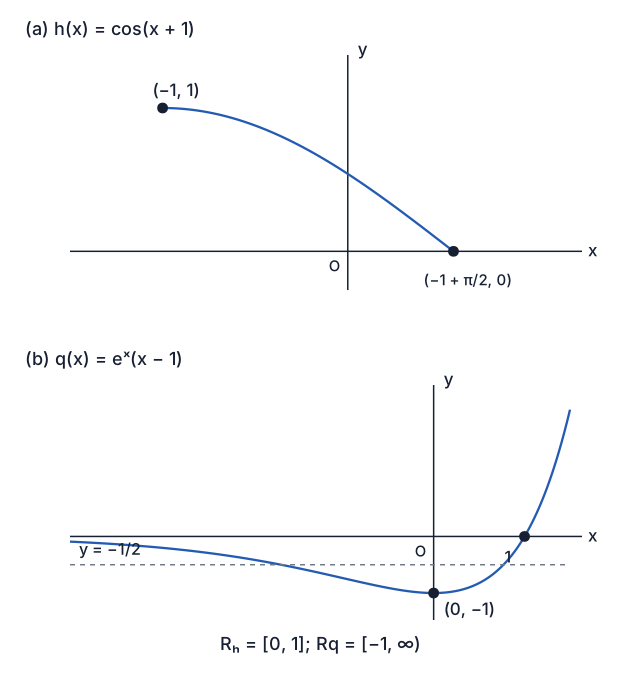
The restricted cosine graph decreases from included (−1,1) to included (−1+π/2,0), passing the horizontal-line test. The graph of eˣ(x−1) approaches zero from below on the left, has minimum (0,−1), crosses the axis at x=1, and meets y=−1/2 twice. Its range is [−1,∞) and it has no inverse on all real inputs.

Common mistakes

An inverse needs one allowed input per output. A familiar formula or a graph that rises somewhere does not establish this for the whole domain.