Porisma

Worked solution

Apply the cosine rule to the included angle

In triangle ABCABC, AB=1AB=1, BC=3BC=3 and angle ABC=θABC=\theta radians. Show that AC=10−6cos⁡θAC=\sqrt{10-6\cos\theta}.

Expand diagram

Use the scrollbars or arrow keys to inspect details.
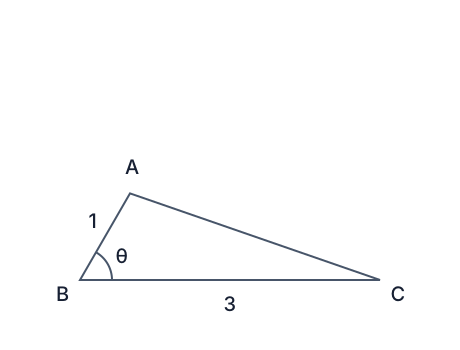
Triangle ABC has B at the lower left, C at the lower right and A above. AB is labelled 1, BC 3 and the included angle ABC is theta. AC is opposite theta; no right angle is given.

[2008/I/6(a)(modified)]

CJC · O Level revision · Example 16

Answer

AC=10−6cos⁡θAC=\sqrt{10-6\cos\theta}.

Compare your reasoning

Use the included angle at B

AC2=AB2+BC2−2(AB)(BC)cos⁡θ=1+9−2(3)cos⁡θ=10−6cos⁡θ\begin{aligned}&AC^2\\ & =AB^2+BC^2-2(AB)(BC)\cos\theta\\ & =1+9-2(3)\cos\theta\\ & =10-6\cos\theta\end{aligned}

The opposite side is AC; the two adjacent sides have lengths 1 and 3.

Take the positive length

AC=10−6cos⁡θAC=\sqrt{10-6\cos\theta}

A side length is positive. The negative square root is not a second side length.

How did this question go?