Porisma

Worked solution

Use the inverse-cosine quadrant before a double angle

If θ=cos⁡−1(−1/3)\theta=\cos^{-1}(-1/\sqrt3), where 0<θ<π0<\theta<\pi, find the exact values of (i) sin⁡θ\sin\theta and (ii) sin⁡2θ\sin2\theta.

CJC · O Level revision · Example 18

(i) Use the positive height in quadrant II

Answer

sin⁡θ=23=23\sin\theta=\dfrac{\sqrt2}{\sqrt3}=\sqrt{\dfrac23}.

Select the quadrant and construct the triangle

y=(3)2−(−1)2=2,sin⁡θ=23=23y=\sqrt{(\sqrt3)^2-(-1)^2}=\sqrt2,\qquad\sin\theta=\frac{\sqrt2}{\sqrt3}=\sqrt{\frac23}

The source uses cos⁡θ=−1/3<0\cos\theta=-1/\sqrt3<0 and the given interval to obtain π/2<θ<π\pi/2<\theta<\pi. Horizontal displacement −1 and hypotenuse √3 therefore give a positive height.

Expand diagram

Use the scrollbars or arrow keys to inspect details.
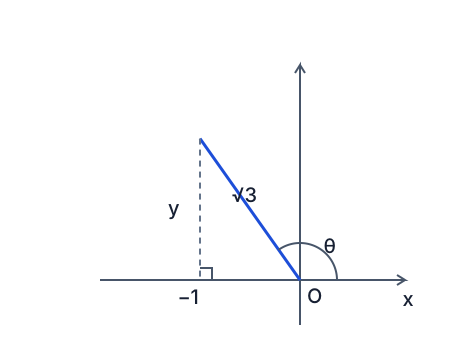
Quadrant-II position triangle from O to (−1,√2): horizontal signed displacement −1, positive vertical height y=√2 and hypotenuse√3. Theta is measured anticlockwise from the positive x-axis to the quadrant-II ray.
How did this part go?

(ii) Preserve the negative cosine factor

Answer

sin⁡2θ=−223\sin2\theta=-\dfrac{2\sqrt2}3.

Apply the double-angle formula

sin⁡2θ=2sin⁡θcos⁡θ=223(−13)=−223\sin2\theta=2\sin\theta\cos\theta=2\sqrt{\frac23}\left(-\frac1{\sqrt3}\right)=-\frac{2\sqrt2}3

The source callout uses sin2θ=2sinθcosθ. The sine is positive and cosine negative.

How did this part go?