Worked solution
Translate left-handedness counts into binomial probabilities
In a particular large population, 15% of people are left-handed and the rest are right-handed. Twelve people are selected at random. Find the probability that (i) exactly 2 are left-handed, (ii) at most 3 are left-handed, (iii) more than 4 are left-handed, (iv) at least 7 are not left-handed, and (v) there are between 3 and 9 left-handed people.
CJC · Lecture · Example 2
State the count and model
Let X count the left-handed people among the 12 selected. Use . The source lists all four conditions: 12 repeated trials; left-handed/not-left-handed categories; constant success probability 0.15; and independence of each person’s handedness in the sampling model. For sampling without replacement from a large finite population, this independence is an approximation justified when the sample is negligible relative to the population; random selection alone does not make arbitrary samples independent.
(i) Formula method: exactly two
to 3 significant figures.
(i) Calculator method: binompdf
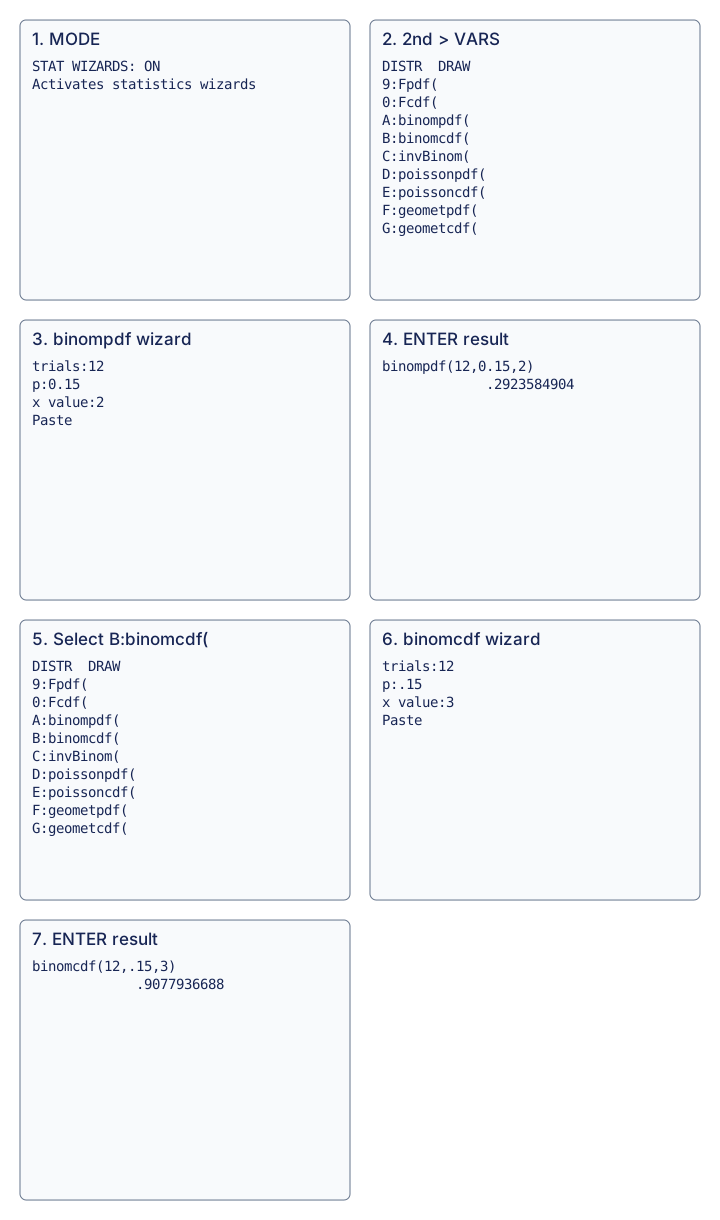
- Press MODE and set STAT WIZARDS: ON to activate the statistics input wizard. 2. Press 2nd, VARS; select A:binompdf( and ENTER. The source expands the name as binomial probability distribution function; here it computes one probability mass. 3. Enter trials:12, p:0.15, x value:2, highlight Paste, then ENTER. 4. Press ENTER again. The home screen shows
binompdf(12,0.15,2)with output 0.2923584904, hence 0.292 to 3 significant figures.
(ii) Formula method: at most three
. Retain all four source terms: to 3 significant figures.
(ii) Calculator method: binomcdf
- Press 2nd, VARS; select B:binomcdf( and ENTER. The command name means binomial cumulative distribution function and computes . 2. Enter trials:12, p:0.15, x value:3, choose Paste, then ENTER. 3. Press ENTER again. The source home screen is
binomcdf(12,.15,3)with output 0.9077936688, hence 0.908 to 3 significant figures.
(iii) More than four
to 3 significant figures. Subtract the cumulative probability at 4, not at 3.
(iv) At least seven are not left-handed
Twelve minus X is the number who are not left-handed. Thus means . The required probability is to 3 significant figures.
(v) Between three and nine
The source explicitly uses strict endpoints: to 3 significant figures. Its later remark says “between” excludes the endpoints; retain this convention for this question, but use an explicitly stated inequality when another problem specifies inclusive endpoints.
Compare your sketch
Calculate a binomial probability
1. Turn on the statistics wizard
Press MODE and set STAT WIZARDS to ON. Press 2nd, then VARS, to open DISTR.
2. Find the probability of exactly two
Select A:binompdf(. Enter the three fields, choose Paste, then press ENTER.
- trials
- 12
- p
- 0.15
- x value
- 2
binompdf(12,0.15,2) ≈ 0.2923584904
3. Find the probability of at most three
Return to DISTR and select B:binomcdf(. Choose Paste, then press ENTER.
- trials
- 12
- p
- 0.15
- x value
- 3
binomcdf(12,0.15,3) ≈ 0.9077936688
For this discrete model, binompdf gives one probability mass P(X = x); binomcdf gives P(X ≤ x), including the entered endpoint. Translate the event before choosing a command. Menu labels follow the retained source calculator.
View original calculator screens
Expand diagramFit diagram to page
Use the scrollbars or arrow keys to inspect details.
Common mistakes
Translate the words into an integer event before choosing a calculator command.