Worked solution
Find the smallest battery sample below a probability bound
Twenty percent of batteries produced by a machine are faulty. Find the smallest sample size for which the probability of fewer than 12 faulty batteries is less than 0.65.
CJC · Lecture · Example 5
Define the model and integer event
Let X count faulty batteries among n sampled batteries. Under the source constant-probability independent-battery model, . Require , equivalently . These count, parameter and inequality entries complete the Student blanks using the Teacher copy.
Use the cumulative calculator function
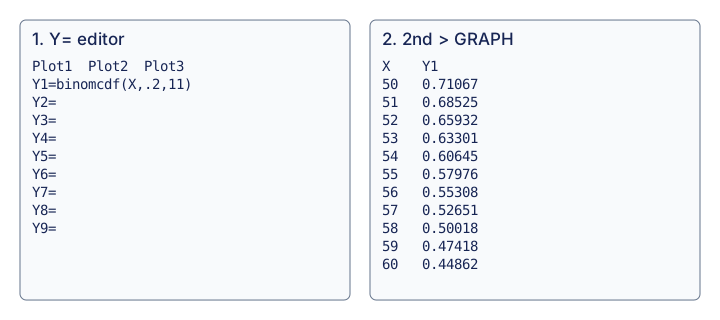
Enter Y1=binomcdf(X,0.2,11) and press 2nd, GRAPH. Here the calculator X is the sample-size input n. The source instruction calls this a probability distribution function , but its actual screen and required event use the cumulative probability . Retain the Teacher boundary table:
| n | |
|---|---|
| 52 | 0.65932 |
| 53 | 0.63301 |
| 54 | 0.60645 |
Select the first qualifying integer
At n=52 the probability 0.65932 is above 0.65; at n=53 the probability 0.63301 is below 0.65, and n=54 gives 0.60645. Thus the smallest sample size is 53. The cumulative probability of at most 11 faults cannot increase as independent trials with the same positive fault probability are added, so checking this first crossing establishes the minimum.
Compare your sketch
Find the first sample size below a probability bound
1. Translate the strict count bound
Fewer than 12 faulty batteries means at most 11. Keep the fault probability 0.2 fixed and vary the sample size n.
2. Enter the cumulative probability
In Y= enter the following, then press 2nd → GRAPH. The calculator X stands for n.
- Y1
- binomcdf(X,0.2,11)
3. Check both sides of the first crossing
Compare the cumulative probability with 0.65.
Check both sides of the first crossing n Displayed P(at most 11) 52 0.65932 53 0.63301 54 0.60645 Smallest qualifying integer: n = 53
At 52 the probability is above 0.65; at 53 it is below. This cumulative probability cannot increase when independent trials with the same positive fault probability are added. The source calls the command a point probability in one instruction; its actual binomcdf entry is cumulative.
View original calculator screens
Expand diagramFit diagram to page
Use the scrollbars or arrow keys to inspect details.
Common mistakes
A strict “fewer than 12” event uses the cumulative probability at 11.