Worked solution
Find the least integer threshold for late days
A student has probability 0.1 of being late for school on any day. In 18 days, the probability of being late on fewer than r days must exceed 0.85. Find the least r.
CJC · Lecture · Example 6
Name the count and translate the requirement
Let X count late days among 18 days. With the source independent-day model and constant probability 0.1, . The condition is , hence for integer r. The source treats r as an integer day-count threshold. Without that interpretation there would be no least real r: every r just above 3 would already include X=3.
Use the source threshold table
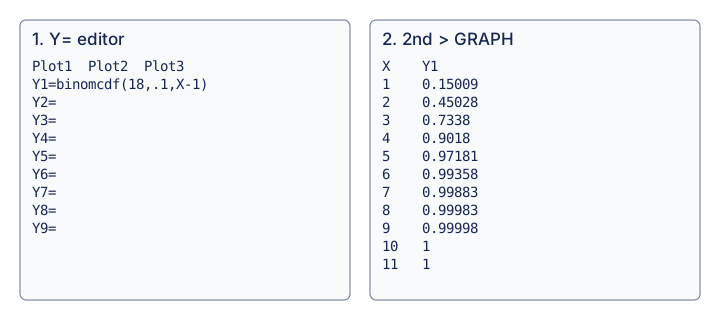
Enter Y1=binomcdf(18,0.1,X-1), then press 2nd, GRAPH. The calculator X now stands for r. Retain the Teacher completion:
| r | |
|---|---|
| 3 | 0.7338 |
| 4 | 0.9018 |
| 5 | 0.97181 |
The probability increases with r. At 3 it is below 0.85; at 4 it is above 0.85. Therefore the least integer r is 4.
Compare your sketch
Find the least integer threshold
1. Identify the unknown
Keep n=18 and p=0.1 fixed. For an integer threshold r, fewer than r late days means at most r−1.
2. Enter a varying threshold
In Y= enter the command below, then press 2nd → GRAPH. Here the calculator X stands for r, not n.
- Y1
- binomcdf(18,0.1,X-1)
3. Find the first value above 0.85
Check adjacent integer thresholds.
Find the first value above 0.85 r Displayed P(fewer than r) 3 0.7338 4 0.9018 5 0.97181 Least integer threshold: r = 4
The threshold is an integer in this question. Keep the r−1 adjustment and the strict probability bound: the entry at r=3 is too small, while r=4 qualifies.
View original calculator screens
Expand diagramFit diagram to page
Use the scrollbars or arrow keys to inspect details.
Common mistakes
Vary the threshold r, keeping n=18 fixed; use r−1 for a strict count bound.