Worked solution
Write an equation before solving for a game probability
A child wins each computer game with probability p. Out of 20 games, the probability of at least two wins is 0.06. Write an equation for p and solve it numerically.
CJC · Lecture · Example 7
Expand the binomial probability equation
Let X count wins among 20 games; under the source constant-p independent-game model, . Then , so . The source expansion is , giving .
Use the calculator intersection or zero method
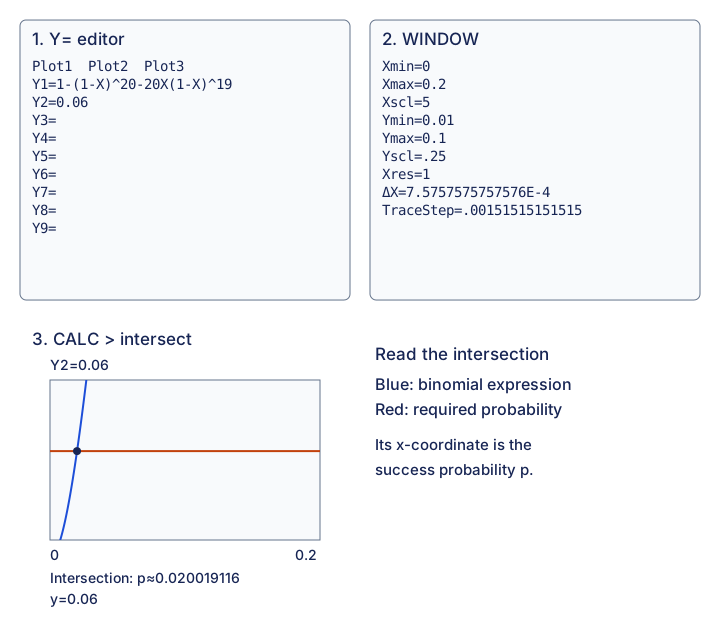
Enter the left-hand expression as Y1 and 0.06 as Y2. Adjust the window to show the intersection, then use the calculator’s intersection command: its x-coordinate is p. The printed window is Xmin 0, Xmax 0.2, Xscl 5, Ymin 0.01, Ymax 0.1, Yscl 0.25, Xres 1 (derived ΔX≈0.000757576, TraceStep≈0.00151515). The numerical result is , hence 0.0200 to 3 significant figures. The source alternative is to plot and find its x-intercept.
Match the method to the unknown
The source remark requires an explicit equation from the MF27 probability formula when asked to “write down an equation”. The Teacher warns against the integer-table search used for a trial count because p is not an integer. More precisely, a calculator table can use decimal increments and help bracket p, but an integer-step table is unsuitable and does not supply the requested numerical root. Use an intersection or zero calculation for the final solution with .
Compare your sketch
Solve for a game success probability
1. Write the probability equation
At least two wins in 20 games has probability 0.06. Complement zero and one wins to write 1−(1−p)²⁰−20p(1−p)¹⁹=0.06.
2. Enter both sides in the Y-editor
The calculator X now stands for the unknown probability p.
- Y1
- 1-(1-X)^20-20X(1-X)^19
- Y2
- 0.06
3. Choose a window that shows the crossing
The retained source uses these bounds. Its complete settings and plotted screens remain below.
- Xmin
- 0
- Xmax
- 0.2
- Ymin
- 0.01
- Ymax
- 0.1
4. Calculate the intersection
Press 2nd → TRACE, choose intersect, select the two curves and provide a nearby guess. Read the x-coordinate as p, not the y-coordinate.
p ≈ 0.020019116; to 3 significant figures: 0.0200
Check 0 ≤ p ≤ 1. This unknown is continuous: an integer-step sample-size table is not the required numerical root solve. If asked for an equation, write it before using the calculator. Displayed intersection values are approximate.
View original calculator screens
Expand diagramFit diagram to page
Use the scrollbars or arrow keys to inspect details.
Common mistakes
An equation in p needs a continuous numerical solve, rather than an integer trial-count search.