Worked solution
Write conjugates and reflect across the real axis
Write down the conjugate of (i) and (ii) .
CJC · Example 5
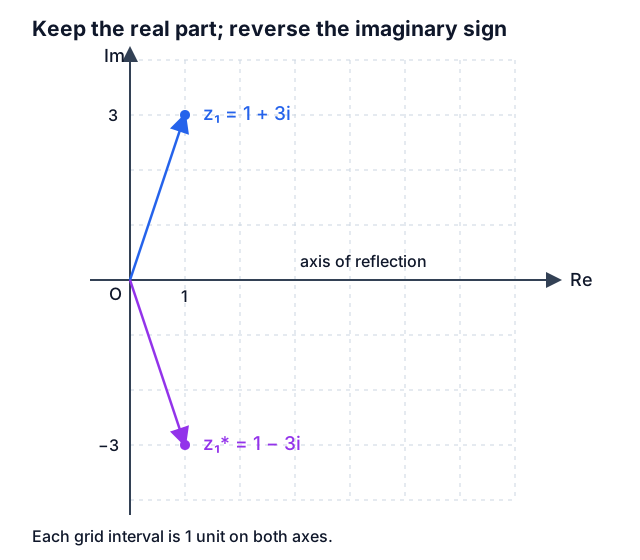
(i) Conjugate of z₁
Answer
.
Keep the real part 1 and reverse the sign of the imaginary coefficient 3. On the Argand plane, reflects in the real axis to .
Expand diagramFit diagram to page
Use the scrollbars or arrow keys to inspect details.
How did this part go?
(ii) Conjugate of z₂
Answer
.
Keep the real part and reverse the imaginary coefficient from to . Conjugate pairs have the same real part and imaginary parts of equal magnitude and opposite signs.
How did this part go?
Solution notes
Calculator procedure from pages 13–14: MODE → a+bi; MATH → CMPLX → 1:conj(. Enter 1+3i and close the parenthesis to obtain 1−3i. Repeat with −1−4i to obtain −1+4i. These are the two source screen outputs.