Worked solution
Find exact moduli and arguments in eight positions
Determine, in exact form, the modulus and argument of:
(a) ; (b) ; (c) ; (d) ;
(e) ; (f) ; (g) ; (h) .
CJC · Example 15
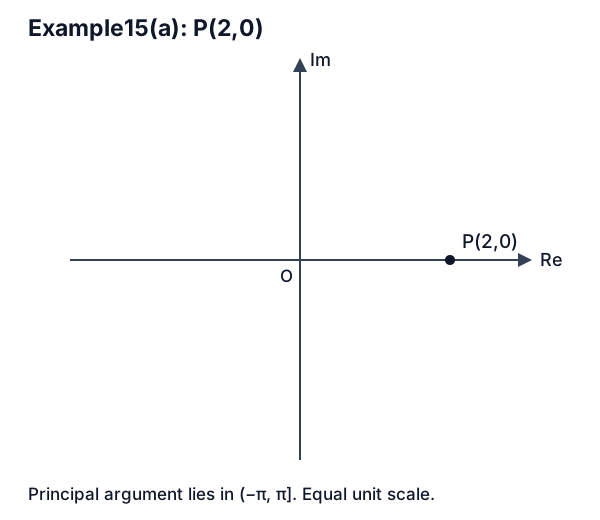
(a) Positive real axis
Answer
Modulus ; principal argument .
. The point is on the positive real axis, so .
Expand diagramFit diagram to page
Use the scrollbars or arrow keys to inspect details.
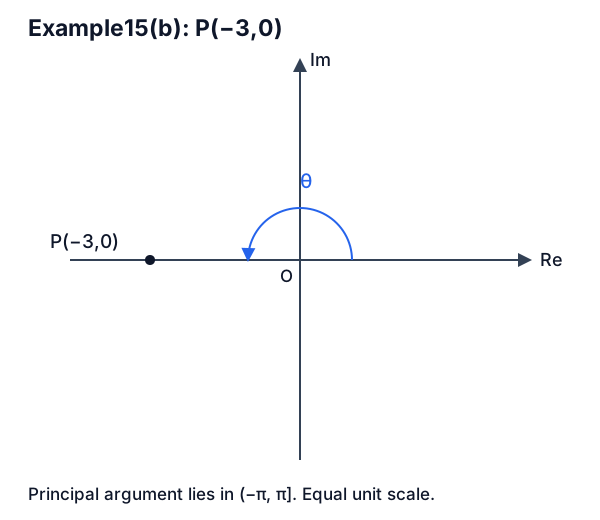
(b) Negative real axis
Answer
Modulus ; principal argument .
. The negative real axis has principal argument in .
Expand diagramFit diagram to page
Use the scrollbars or arrow keys to inspect details.
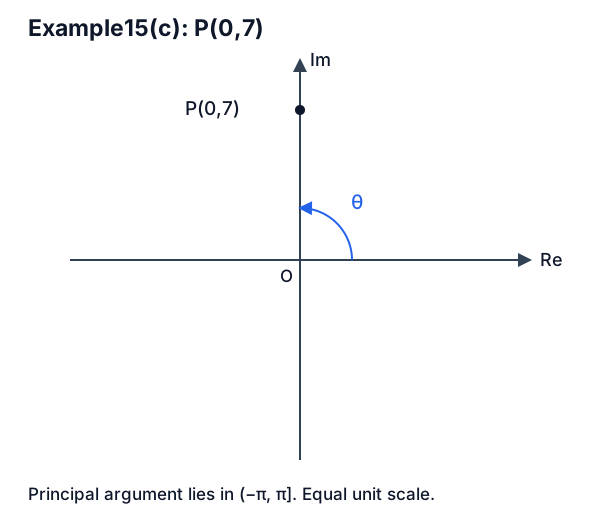
(c) Positive imaginary axis
Answer
Modulus ; principal argument .
. The positive imaginary axis gives .
Expand diagramFit diagram to page
Use the scrollbars or arrow keys to inspect details.
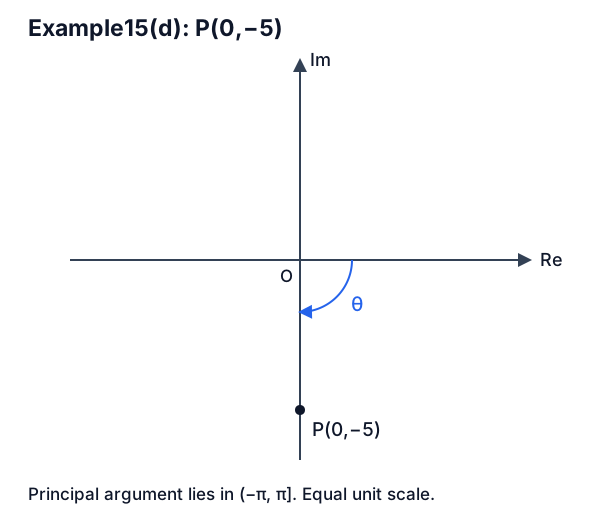
(d) Negative imaginary axis
Answer
Modulus ; principal argument .
. The negative imaginary axis gives .
Expand diagramFit diagram to page
Use the scrollbars or arrow keys to inspect details.
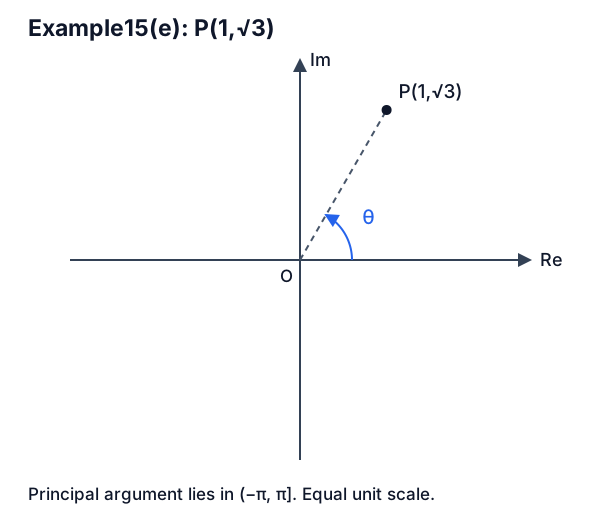
(e) First quadrant
Answer
Modulus ; principal argument .
. The point is in quadrant I, so .
Expand diagramFit diagram to page
Use the scrollbars or arrow keys to inspect details.
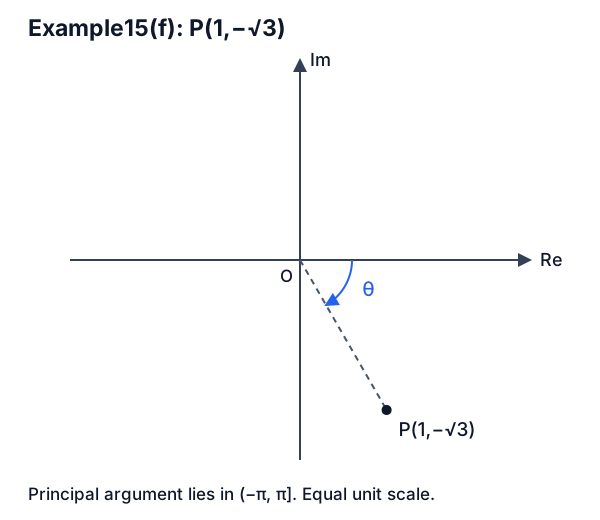
(f) Fourth quadrant
Answer
Modulus ; principal argument .
. In quadrant IV, .
Expand diagramFit diagram to page
Use the scrollbars or arrow keys to inspect details.
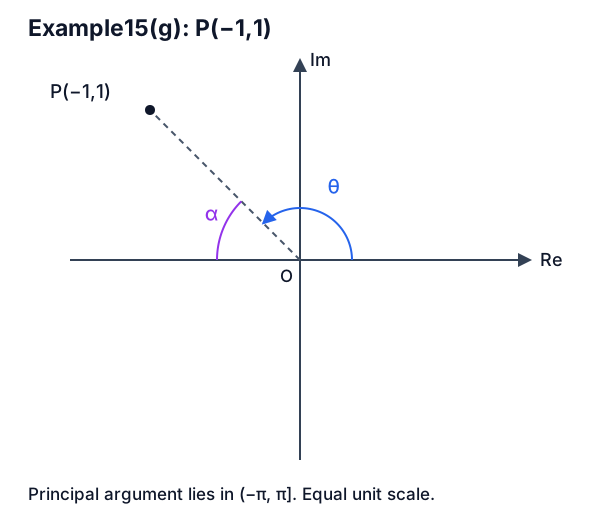
(g) Second quadrant
Answer
Modulus ; principal argument .
. In quadrant II, , so .
Expand diagramFit diagram to page
Use the scrollbars or arrow keys to inspect details.
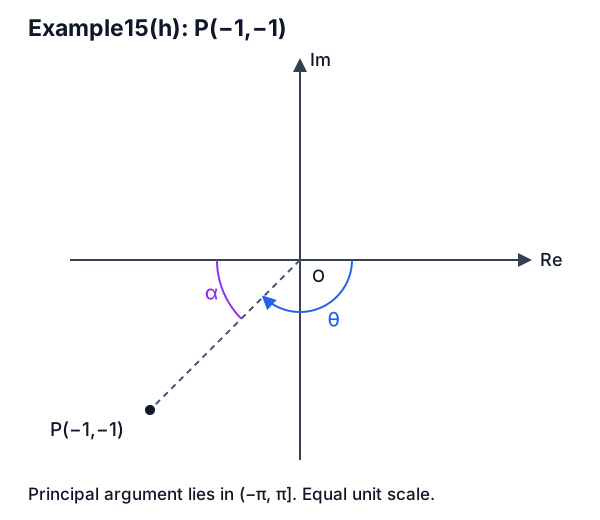
(h) Third quadrant
Answer
Modulus ; principal argument .
. In quadrant III, , so .
Expand diagramFit diagram to page
Use the scrollbars or arrow keys to inspect details.
Solution notes
Use the source interval for principal arguments. For (h), calculator modulus procedure: MATH → CMPLX → 5:abs(; enter −1−i and press ENTER. The screen gives 1.414213562, checking . For argument: MATH → CMPLX → 4:angle (; enter −1−i and press ENTER in radian mode. The screen gives −2.35619449, checking .
The source points to Appendix C on page 42 for further modulus/argument rules and labels them non-examinable in its H2 syllabus. This retains the source guidance, without asserting a current syllabus classification.