Porisma

Worked solution

Sketch complex sums and prove a square

The complex numbers zz and ww are given by z=3+iz=\sqrt3+i and w=−1+i3w=-1+i\sqrt3.

Sketch an Argand diagram, with origin OO, showing the points ZZ, WW and PP representing zz, ww and z+wz+w respectively. Show that OWPZOWPZ is a square.

2010/MJC/I/11(b)(part)

CJC · Example 16

Locate the points and their sum

Answer

Z(3,1)Z(\sqrt3,1), W(−1,3)W(-1,\sqrt3), P(3−1,1+3)P(\sqrt3-1,1+\sqrt3).

Add corresponding components: z+w=(3−1)+i(1+3)z+w=(\sqrt3-1)+i(1+\sqrt3). The points form the parallelogram OWPZOWPZ, since WP→=OZ→\overrightarrow{WP}=\overrightarrow{OZ} and ZP→=OW→\overrightarrow{ZP}=\overrightarrow{OW}.

Expand diagram

Use the scrollbars or arrow keys to inspect details.
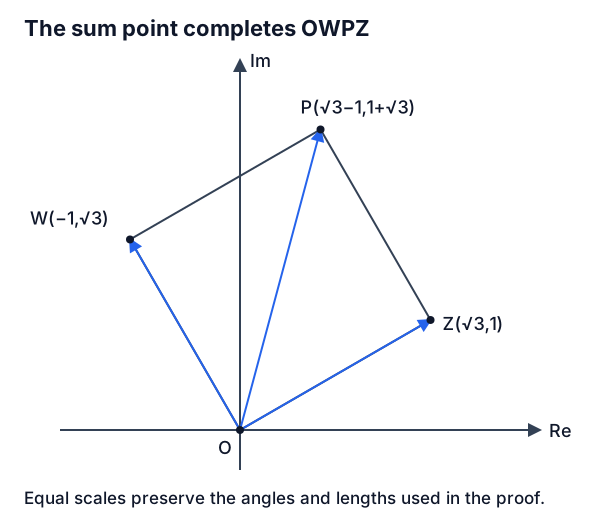
Equal-unit Argand axes show O=(0,0), Z=(sqrt3,1), W=(-1,sqrt3), P=(sqrt3-1,1+sqrt3), with outline O-W-P-Z-O and origin arrows to W,Z,P. It is the source sum parallelogram; its right angle and equal adjacent lengths are proved in the next part.
How did this part go?

Show a right angle and equal adjacent sides

Answer

OWPZOWPZ is a square.

The directions of the two adjacent position vectors are

arg⁡(z)=tan⁡−113=π6,arg⁡(w)=π−tan⁡−131=2π3.\begin{aligned}\arg(z)&=\tan^{-1}\frac1{\sqrt3}=\frac\pi6,\\\arg(w)&=\pi-\tan^{-1}\frac{\sqrt3}{1}=\frac{2\pi}3.\end{aligned}

Hence

∠WOZ=2π3−π6=π2.\angle WOZ=\frac{2\pi}3-\frac\pi6=\frac\pi2.

Also OZ=∣z∣=(3)2+12=2OZ=|z|=\sqrt{(\sqrt3)^2+1^2}=2 and OW=∣w∣=∣−1+i3∣=(−1)2+(3)2=2OW=|w|=|-1+i\sqrt3|=\sqrt{(-1)^2+(\sqrt3)^2}=2. The parallelogram has a right angle and equal adjacent sides, so it is a square.

How did this part go?