Worked solution
Two parabola sketches: algebra and calculator branches
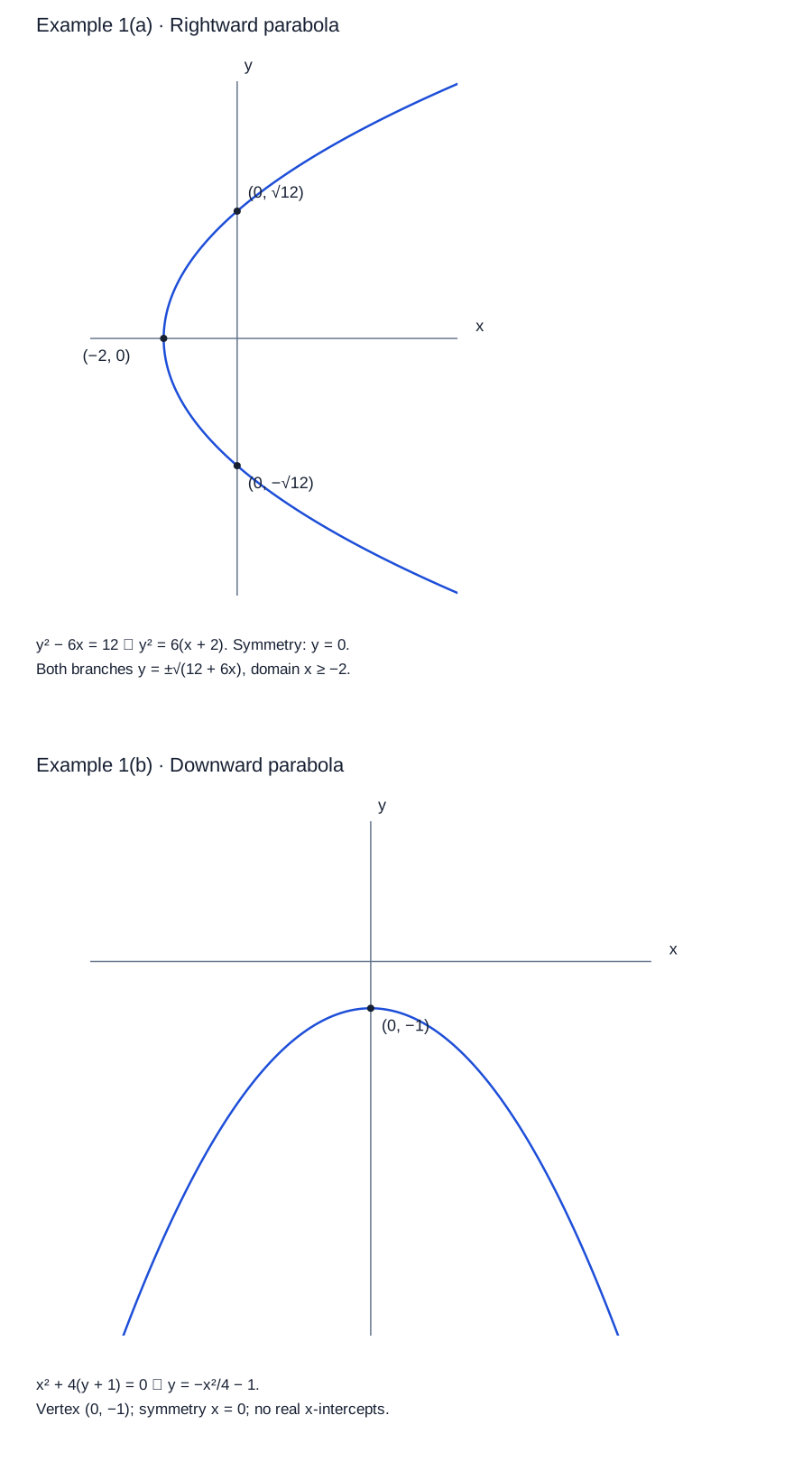
Sketch the curves (a) and (b) , and state the line(s) of symmetry.
CJC · Lecture · Example 1
(a) Algebraic method
. Comparing gives vertex and symmetry . The parabola opens right. At , ; at , . Both upper and lower branches belong to the curve.
(b) Algebraic method
. The vertex is , the graph opens down and its line of symmetry is . The only axial intercept is : would require , so there is no real -intercept.
(a) Calculator method
For the source’s function-graphing workflow, first make the subject: . In the source table, press y= and enter and , then graph. Both have real domain . Use the displayed 2nd, trace workflow to locate intercepts numerically. The source explicitly warns that those readings are non-exact: retain as exact intercepts. Its two screen displays show these two entries, then their joined rightward parabola; the independently drawn solution figure preserves that mathematics rather than reproducing the calculator interface.
Compare your sketch
Expand diagramFit diagram to page
Use the scrollbars or arrow keys to inspect details.
Common mistakes
A sideways parabola needs both explicit y-branches in a function plot. Decimal calculator intercepts do not replace the exact radical coordinates.
Solution notes
Question: CJC Conics Student copy, PDF pp.[4, 5], printed pp.[116, 117]. Working compared with the matching Teacher copy at the same pages.
No marks are printed for these examples. The original native text from both copies is retained; teacher additions are integrated into the relevant working.