Worked solution
Read a parabola’s vertex and choose an equation
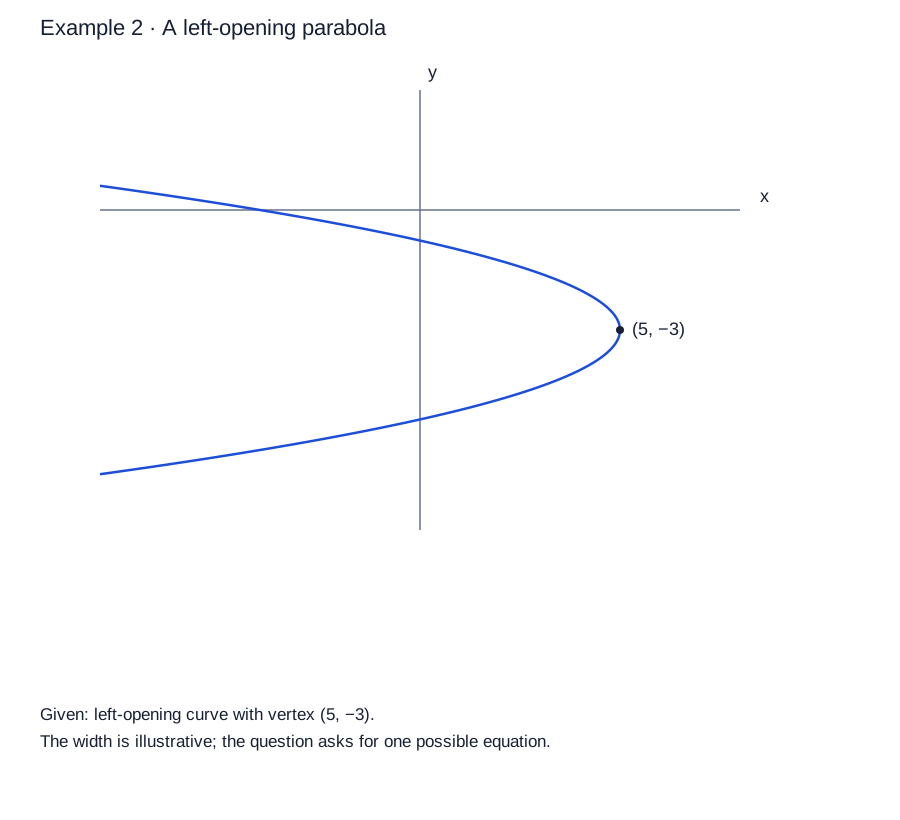
Write down one possible equation of the parabola shown in the diagram.
Expand diagramFit diagram to page
Use the scrollbars or arrow keys to inspect details.
CJC · Lecture · Example 2
Read the vertex and direction
The teacher solution uses with . The labelled vertex gives ; opening left fixes the sign of , but the diagram does not fix its magnitude.
Choose one admissible coefficient
Choose : one possible equation is . More generally, every equation with has the stated vertex and orientation. The teacher copy’s choice is one example, not a uniquely determined equation.
Common mistakes
A vertex and opening direction leave infinitely many possible widths. Do not infer an exact coefficient from an illustrative sketch.
Solution notes
Question: CJC Conics Student copy, PDF pp.[5], printed pp.[117]. Working compared with the matching Teacher copy at the same pages.
No marks are printed for these examples. The original native text from both copies is retained; teacher additions are integrated into the relevant working.