Worked solution
An ellipse with equal radii
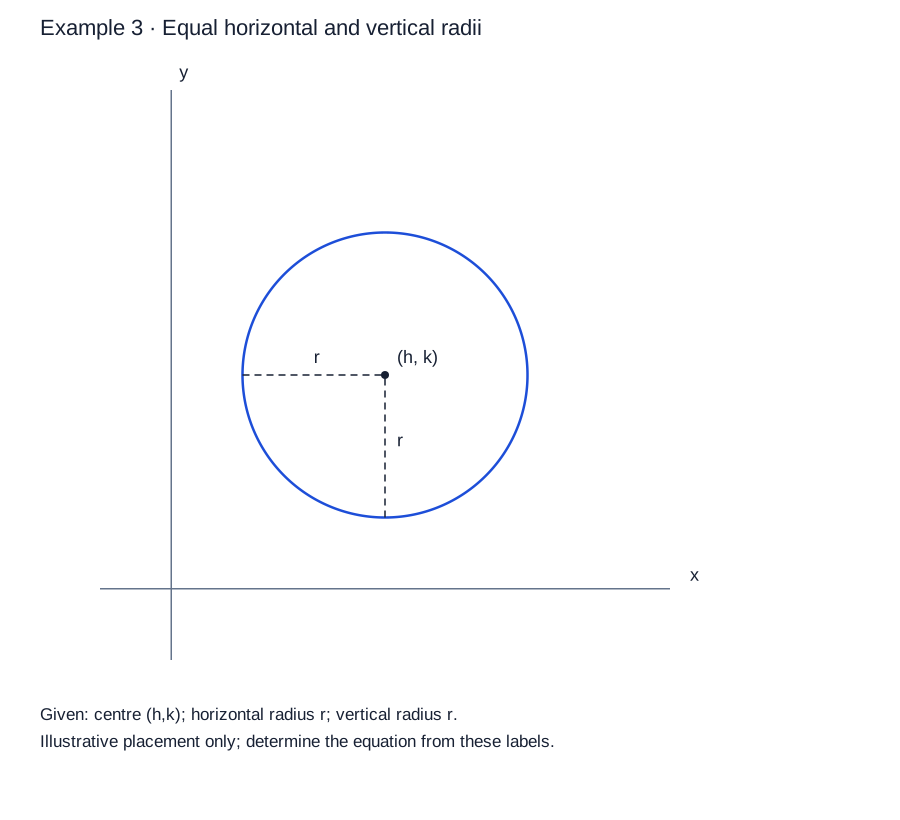
Write down the equation of the ellipse shown in the diagram.
Expand diagramFit diagram to page
Use the scrollbars or arrow keys to inspect details.
CJC · Lecture · Example 3
Read the two radii
The general centred form is . Both labelled semi-axes in the diagram are , so . The curve is a circle, a special case of an ellipse.
Write the equation
. Multiplying by gives , the circle with centre and radius . The source’s concluding remark is that a circle is an ellipse with equal axes.
Common mistakes
Use r² in each denominator. Equal semi-axis lengths describe a circle; the orientation of the drawn radius segments does not change its equation.
Solution notes
Student and Teacher copies, PDF page 8, printed page 120. Both show the same completed derivation and equal-axes remark. No marks are printed.
Only symbolic centre and radius labels are given; the numerical placement and size in the reconstructed diagram are illustrative.