Worked solution
Two horizontal hyperbolas: algebra and calculator checks
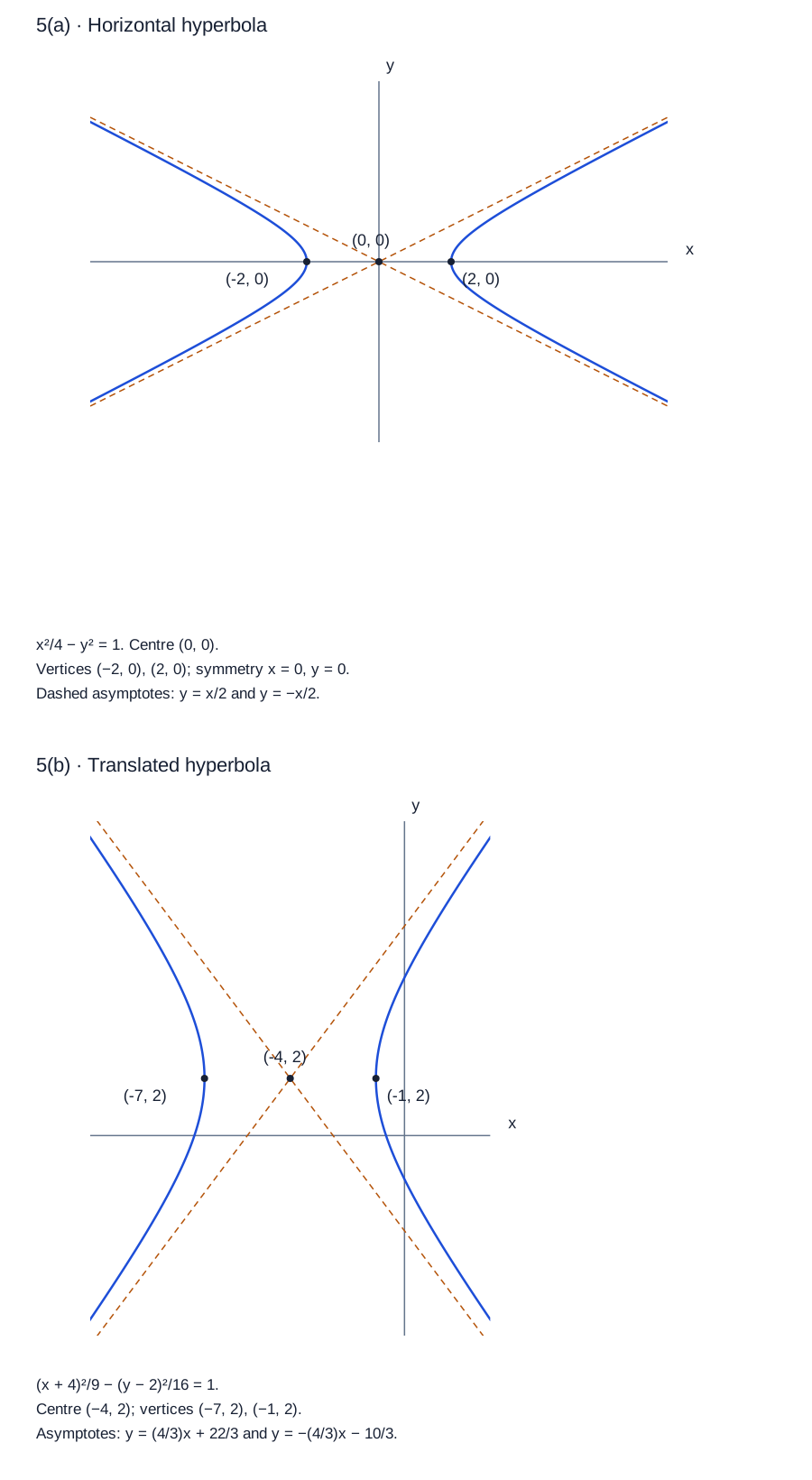
Sketch the hyperbolas:
(a) ,
(b) ,
and state the line(s) of symmetry.
CJC · Lecture · Example 5
(a) Algebraic method
, so the centre is and the vertices are . Set the right side to zero for asymptotes: , hence and . The lines of symmetry are . Draw two horizontal branches approaching these lines. This working fills the Student copy’s blanks using the compared Teacher copy.
(b) Algebraic method
, giving centre and vertices . The homogeneous equation is , or . Thus and the asymptotes are and . Symmetry lines: .
(a) Conics application and window controls
Follow the source table: apps → [2:Conics] → [3:HYPERBOLA]. Press mode for CONIC SETTINGS, choose FUNC (functions) and MAN (manual window settings), then ESC to return. Select [1:], the horizontal form . Enter A=2, B=1, H=0, K=0. To SOLVE, press alpha, enter. The feature screen shows centre , vertices , focus readouts and , and slope . The focus readouts are displayed decimals; the exact focus coordinates are (an authored check). The centre/vertices give symmetry , and the slope gives asymptotes . Press graph; trace coordinates may be inaccurate. Press zoom for the displayed choices 1:Zoom Conic, 2:Zoom In, 3:Zoom Out, 4:ZBox, 5:ZSquare, 6:ZStandard. Without MAN, the source says a Zoom Conic command is performed by default. In MAN, press window for manual controls; the screenshot has Xmin=−10, Xmax=10, Xscl=1, Ymin=−10, Ymax=10, Yscl=1. These are source display settings, not part of the equation.
(b) Conics application
Select horizontal form [1:] and enter A=3, B=4, H=−4, K=2. Press alpha, enter to SOLVE. The feature screen shows centre , vertices , foci and slope readout . The exact slopes are . The centre/vertices give symmetry ; combine the slopes with the centre to obtain , not lines through the origin. Press graph and trace if needed, retaining the source warning about numerical trace accuracy. The exact foci also follow from (an authored verification).
Compare your sketch
Expand diagramFit diagram to page
Use the scrollbars or arrow keys to inspect details.
Common mistakes
For a translated hyperbola, asymptote slopes alone are not equations. Use the centre to determine the intercepts.
Solution notes
Student/Teacher PDF pages 17–19, printed pages 129–131. No marks printed. Both source asks, algebraic method, Conics screens, settings and feature values compared. Teacher fills the first part’s working and symmetry answers.
The Student sketch in (a) places the two vertex dots above the x-axis despite labelling them (−2,0),(2,0). The equation and Teacher sketch put them on the axis; the reconstruction follows those consistent coordinates and records the original discrepancy here.
Source screenshots retained in the original PDFs; mathematical input, feature readouts, menu/window settings and warnings transcribed into accessible working. Decimal focus/slope readouts are not substituted for exact values.