Worked solution
Recover a vertical hyperbola from vertices and asymptotes
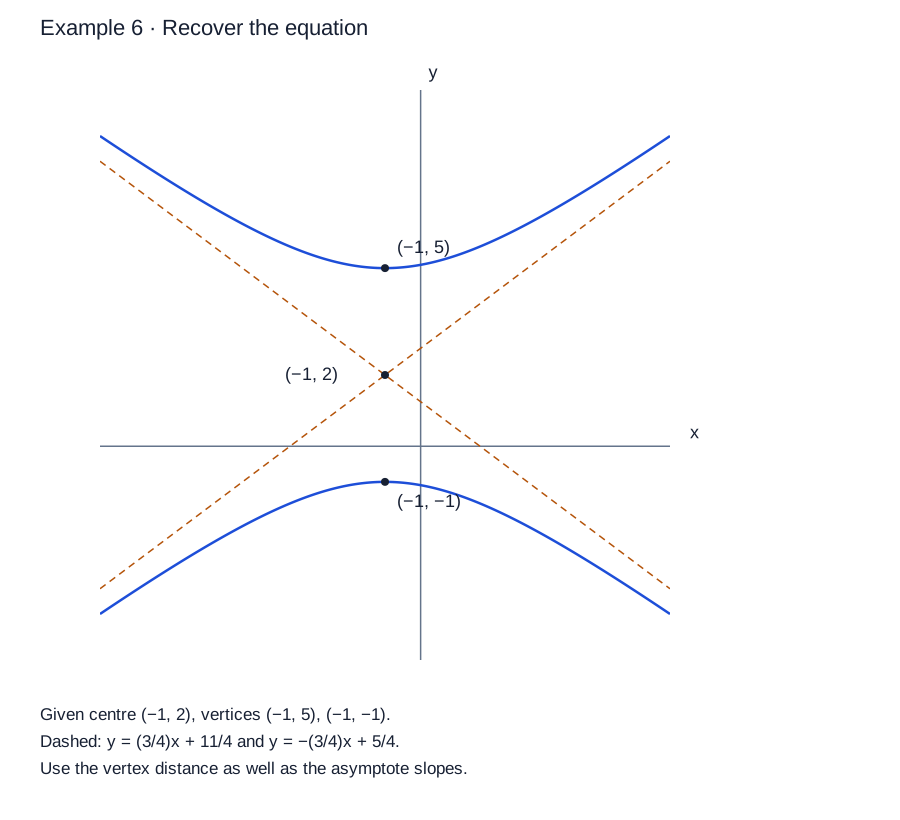
Find the equation of the hyperbola shown below.
Expand diagramFit diagram to page
Use the scrollbars or arrow keys to inspect details.
CJC · Lecture · Example 6
Read the centre and vertical size
Use the vertical form . The centre is , so . The vertices are each units vertically from the centre, so . This is the Teacher copy’s alternative-method note: the given vertex ordinates fix .
Use the asymptote slopes
The given lines and rewrite as . Compare with : . Together with , this gives . The ratio alone does not fix the sizes of and ; the vertex distance supplies the missing scale.
Write and check the equation
The equation is . It gives vertices and asymptote slopes through , matching all the diagram labels.
Common mistakes
Asymptote slopes determine b/a, not the individual values. Use a vertex to determine the scale.
Solution notes
Student/Teacher PDF 22, printed 134. Teacher alternative note b=3 integrated into the first working step. No marks printed.
The source’s short transition from the ratio to a=4,b=3 uses the plotted vertices as well as the slopes; this dependency is now explicit.