Worked solution
Exact intercepts of a translated vertical hyperbola
Sketch and write down the coordinates of the intercepts, vertices and the equations of all asymptotes and lines of symmetry.
CJC · Lecture · Example 7
Centre and vertices
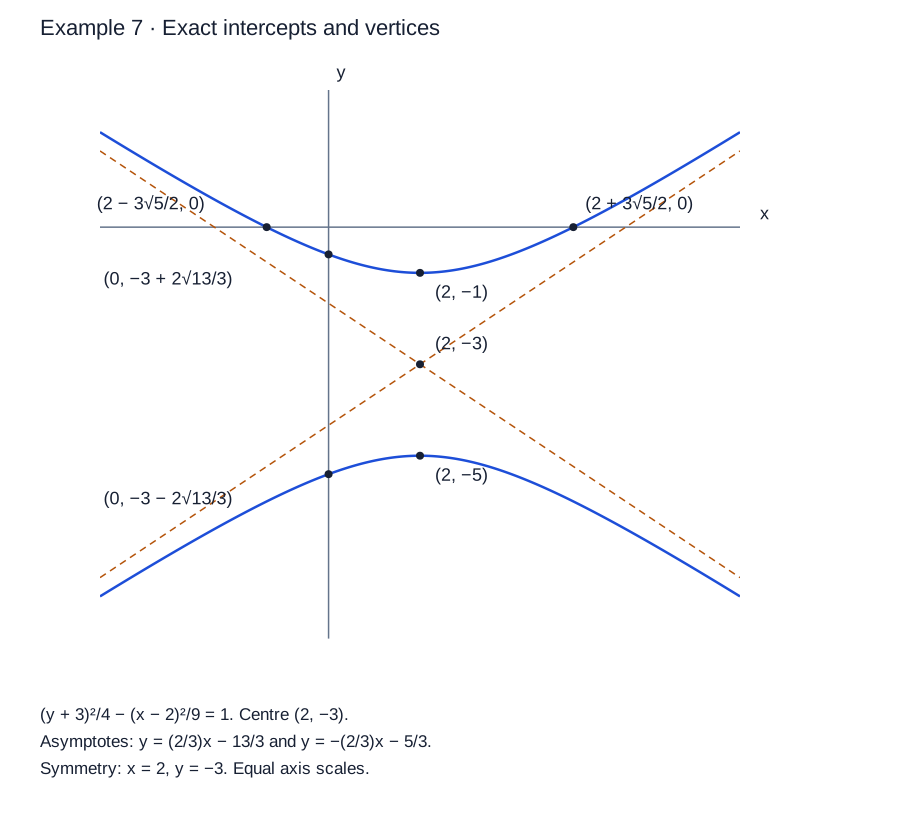
, so centre , vertical vertex distance and vertices . The curve opens up and down.
Exact axial intercepts
At , , so . The -intercepts are . At , , so . The -intercepts are . Keep the radicals exact as printed; the Teacher copy supplies these labels on the Student sketch.
Asymptotes, symmetry and sketch
Set the standard equation’s RHS to zero: . Thus and . The two asymptotes are and . The symmetry lines are . Draw both smooth branches through the exact intercepts and vertices, approaching the two asymptotes. The centre is not a point on either branch.
Compare your sketch
Expand diagramFit diagram to page
Use the scrollbars or arrow keys to inspect details.
Common mistakes
The vertical vertices are not axial intercepts unless they lie on an axis. Retain both ± roots in each intercept calculation.
Solution notes
Student/Teacher PDF 23, printed 135. All printed intercepts, vertices, asymptote derivation and symmetry lines retained. Teacher coordinate labels integrated directly into the sketch and working; no marks printed.