Porisma

Worked solution

Split the area at both roots

Find the area of the region bounded by y=x2−6x+8y=x^2-6x+8, the xx-axis and the lines x=1x=1 and x=5x=5.

CJC · Lecture · Example 7

Sketch and split

Factor x2−6x+8=(x−2)(x−4)x^2-6x+8=(x-2)(x-4). The upward-opening parabola crosses the axis at 22 and 44, with vertex (3,−1)(3,-1). Shade the three pieces between x=1x=1 and x=5x=5: above the axis on [1,2][1,2] and [4,5][4,5], below it on [2,4][2,4].

How did this part go?

Form the area integral

The required area is A=∫12(x2−6x+8) dx−∫24(x2−6x+8) dx+∫45(x2−6x+8) dxA=\int_1^2(x^2-6x+8)\,dx-\int_2^4(x^2-6x+8)\,dx+\int_4^5(x^2-6x+8)\,dx. The Teacher calculator screen enters the same three integrals of Y1Y_1, with signs +,−,++,-,+, and displays 44.

How did this part go?

Evaluate and check the sign

An antiderivative is F(x)=x3/3−3x2+8xF(x)=x^3/3-3x^2+8x. The three signed integrals are 4/3,−4/3,4/34/3,-4/3,4/3, giving A=4/3−(−4/3)+4/3=4A=4/3-(-4/3)+4/3=4 square units. Directly taking ∫15f(x) dx=4/3\int_1^5f(x)\,dx=4/3 would allow cancellation and would not give the area.

How did this part go?

Compare your sketch

Expand diagram

Use the scrollbars or arrow keys to inspect details.
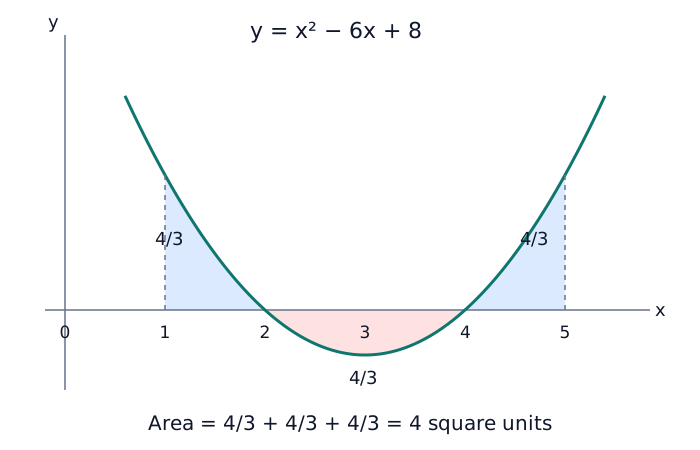
Upward parabola with roots 2 and 4 and vertex (3,−1). Between x=1 and x=5, the two positive pieces and the middle negative piece all contribute positive geometric area.

Common mistakes

Do not integrate across both roots without changing the sign of the below-axis contribution.

Read the hint