Porisma

Worked solution

Use horizontal strips for an inverse-sine boundary

Find the value of the area of the region bounded by y=sin⁡−1xy=\sin^{-1}x and the lines x=0x=0, y=−π/4y=-\pi/4 and y=π/3y=\pi/3.

CJC · Lecture · Example 10

Express the horizontal boundary

The inverse-sine graph runs from (−1,−π/2)(-1,-\pi/2) to (1,π/2)(1,\pi/2) and passes through the origin. Rewrite y=sin⁡−1xy=\sin^{-1}x as x=sin⁡yx=\sin y on the principal inverse-sine range. Horizontal strips run between this curve and the y-axis.

How did this part go?

Split the left and right regions

For −π/4≤y≤0-\pi/4\le y\le0, sin⁡y≤0\sin y\le0, so negate that integral. For 0≤y≤π/30\le y\le\pi/3, sin⁡y≥0\sin y\ge0. Thus A=−∫−π/40sin⁡y dy+∫0π/3sin⁡y dyA=-\int_{-\pi/4}^0\sin y\,dy+\int_0^{\pi/3}\sin y\,dy.

How did this part go?

Evaluate in radians

The Teacher gives A=0.793A=0.793 square units to three significant figures. Independently, using −cos⁡y-\cos y gives A=(1−2/2)+(1−1/2)=3/2−2/2≈0.792893219A=(1-\sqrt2/2)+(1-1/2)=3/2-\sqrt2/2\approx0.792893219. The source calculator remark allows −∫−π/40sin⁡x dx+∫0π/3sin⁡x dx-\int_{-\pi/4}^0\sin x\,dx+\int_0^{\pi/3}\sin x\,dx: xx is just a renamed dummy variable with the same limits. Use radian mode.

How did this part go?

Compare your sketch

Expand diagram

Use the scrollbars or arrow keys to inspect details.
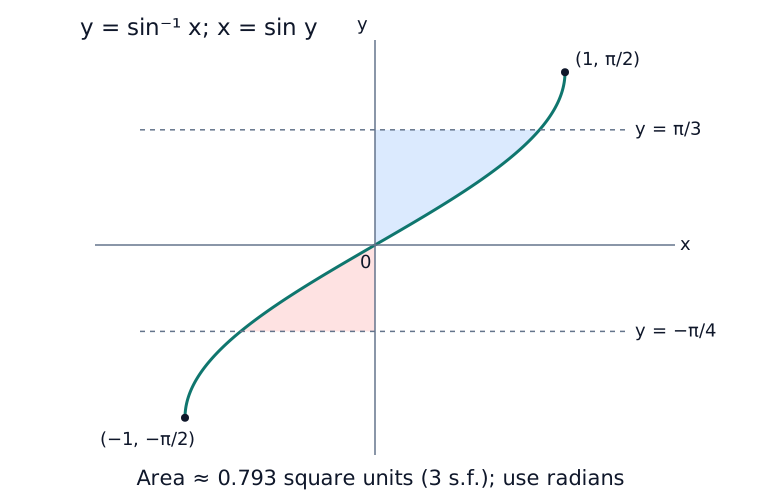
Principal inverse-sine curve with endpoints (−1,−π/2) and (1,π/2). Shade between the y-axis and the curve from y=−π/4 to zero on the left, and zero to π/3 on the right.

Common mistakes

Do not confuse the horizontal strip width sin(y) with its inverse function; the limits are y values in radians.

Read the hint