Porisma

Worked solution

Split three horizontal area pieces

Find the area of the region bounded by 1−x=(y+1)21-x=(y+1)^2, the y-axis, and the lines y=−3y=-3 and y=2y=2.

CJC · Lecture · Example 11

Make x the subject and locate crossings

As the source callout directs, write x=g(y)=1−(y+1)2x=g(y)=1-(y+1)^2. At the y-axis, g(y)=0g(y)=0, giving y=−2y=-2 and y=0y=0. The sideways parabola has vertex (1,−1)(1,-1) and meets the bounds at (−3,−3)(-3,-3) and (−8,2)(-8,2). These vertex coordinates are an independently authored aid to the source sketch.

How did this part go?

Form three positive areas

The curve lies left of the y-axis on [−3,−2][-3,-2] and [0,2][0,2], and right on [−2,0][-2,0]. Hence A=−∫−3−2[1−(y+1)2] dy+∫−20[1−(y+1)2] dy−∫02[1−(y+1)2] dyA=-\int_{-3}^{-2}[1-(y+1)^2]\,dy+\int_{-2}^0[1-(y+1)^2]\,dy-\int_0^2[1-(y+1)^2]\,dy.

How did this part go?

Evaluate the total

The printed answer is 9139\frac13 square units. Independently, an antiderivative is F(y)=−y3/3−y2F(y)=-y^3/3-y^2. The three signed integrals are −4/3-4/3, 4/34/3 and −20/3-20/3. Therefore the geometric area is 4/3+4/3+20/3=28/3=9134/3+4/3+20/3=28/3=9\frac13 square units.

How did this part go?

Compare your sketch

Expand diagram

Use the scrollbars or arrow keys to inspect details.
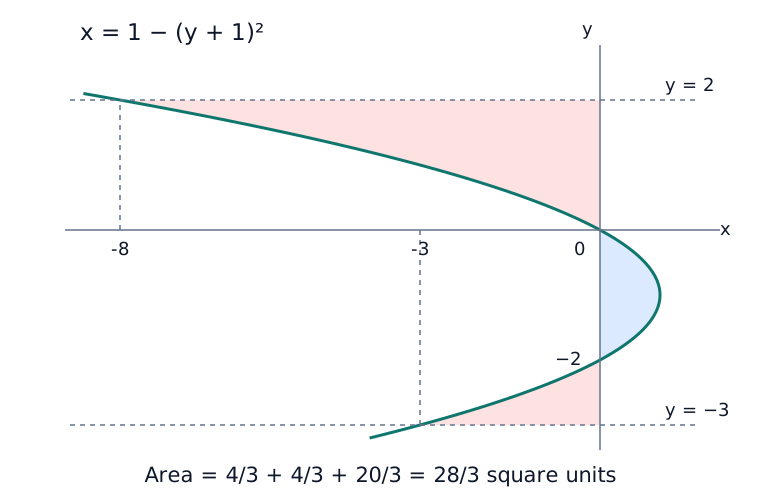
Sideways parabola x=1−(y+1) squared. Three shaded pieces from y=−3 to 2 lie left, right and left of the y-axis, splitting at y=−2 and 0. The bounding endpoints are (−3,−3) and (−8,2).

Common mistakes

Negate both left-of-axis contributions; a single signed integral over −3 to 2 would allow cancellation.

Read the hint