Porisma

Worked solution

Subtract a line from a curve or use a triangle

Find the exact area of the region enclosed by y=2+x−x2y=2+x-x^2 and y=x+1y=x+1.

CJC · Lecture · Example 12

Find exact intersections

Set 2+x−x2=x+12+x-x^2=x+1, so x2=1x^2=1 and x=−1,1x=-1,1. The intersections are (−1,0)(-1,0) and (1,2)(1,2). On this interval the parabola is above the line.

How did this part go?

Integrate upper minus lower

A=∫−11[(2+x−x2)−(x+1)] dx=∫−11(1−x2) dx=[x−x3/3]−11=4/3A=\int_{-1}^1[(2+x-x^2)-(x+1)]\,dx=\int_{-1}^1(1-x^2)\,dx=[x-x^3/3]_{-1}^1=4/3 square units.

How did this part go?

Alternative triangle method

The area under the parabola from −1-1 to 11 is ∫−11(2+x−x2) dx\int_{-1}^1(2+x-x^2)\,dx. The line, x-axis and x=1x=1 bound a triangle with base 22 and height 22. Subtract its area: A=∫−11(2+x−x2) dx−12(2)(2)=10/3−2=4/3A=\int_{-1}^1(2+x-x^2)\,dx-\frac12(2)(2)=10/3-2=4/3 square units. The explicit value 10/310/3 is an independently authored intermediate check.

How did this part go?

Compare your sketch

Expand diagram

Use the scrollbars or arrow keys to inspect details.
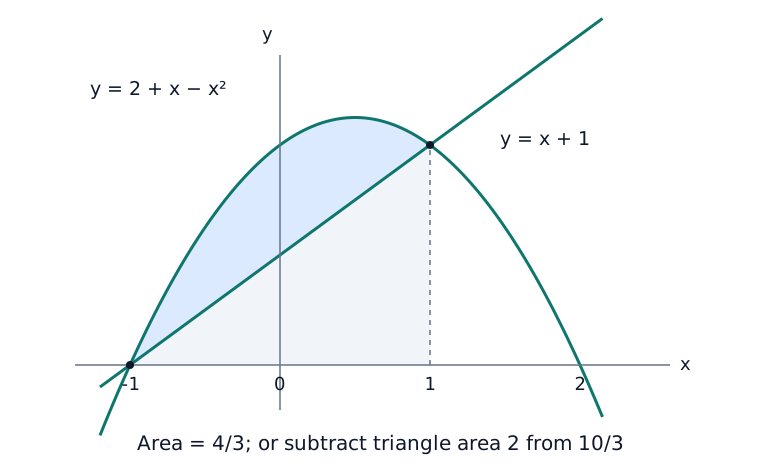
Downward parabola y=2+x−x squared lies above the line y=x+1 between (−1,0) and (1,2). Shade the enclosed region; the triangle below the line has base 2 and height 2.

Common mistakes

Subtract the lower line from the upper parabola between the intersections, or subtract the entire triangle from the curve area; do not mix the two methods.

Read the hint