Worked solution
Use symmetry for a half-turn and translate the rotation axis
The region is bounded by and .
(i) Find the exact volume when is rotated through two right angles about the y-axis.
(ii) Write down the equation of the curve obtained when is translated four units in the negative y-direction. Hence find the approximate volume of the solid formed when is rotated completely about .
CJC · Lecture · Example 16
(i) Account for both sides of R
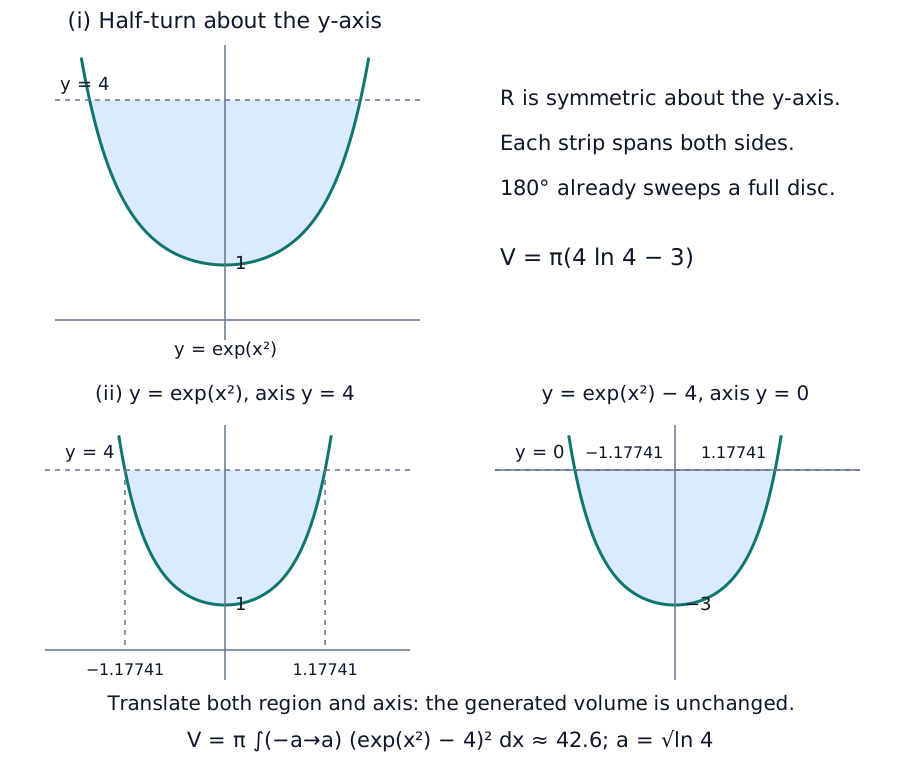
The Teacher emphasises that is even and occupies two quadrants symmetrically about the y-axis. At height , the horizontal strip runs from to . Rotating this whole strip through sweeps a complete disc: its positive and negative halves sweep the two complementary semicircles. Thus there is no extra factor .
(i) Integrate the squared radius
Since , . Using integration by parts, cubic units.
(ii) Translate the curve and region
The translated curve is . Moving the whole region and its axis down by 4 preserves the generated volume: rotation of the original region about becomes rotation of the translated region about the x-axis. Its x-intercepts are , where ; its minimum is .
(ii) Evaluate the approximate volume
. The source uses bounds approximately and gives cubic units to 3 significant figures. The squared function is even, so the Teacher also writes . An independent numerical check with the exact bound gives approximately , agreeing with the printed answer.
Compare your sketch
Expand diagramFit diagram to page
Use the scrollbars or arrow keys to inspect details.
Common mistakes
A half-turn of a region on both sides of its axis can already fill the full solid. Determine the swept region before applying an angle fraction; when translating, move both the region and its axis.