Porisma

Worked solution

Use different regions for area and revolution

The graph shows y=1/(1+x2)y=1/(1+x^2) and y=tan⁡xy=\tan x, where the source prints −π/2≤x≤π/2-\pi/2\le x\le\pi/2.

(i) Find the area bounded by the two curves and x=1x=1.

(ii) Find the volume generated when the region bounded by the two curves and the y-axis is rotated by 2π2\pi radians about the y-axis.

CJC · Lecture · Example 19

Locate the intersection

The source graphing-calculator intersection is (0.62389,0.71981)(0.62389,0.71981). Denote its coordinates by (a,b)(a,b). Keep full calculator precision until the final answer; the source displays rounded limits. Although the printed domain includes both endpoints, tan⁡x\tan x is undefined at ±π/2\pm\pi/2: these are vertical asymptotes and the actual tangent domain here is −π/2<x<π/2-\pi/2<x<\pi/2.

How did this part go?

(i) Area to the right of the intersection

For a≤x≤1a\le x\le1, tan⁡x\tan x is above 1/(1+x2)1/(1+x^2). The Teacher fills A=∫0.623891[tan⁡x−1/(1+x2)] dx=0.179A=\int_{0.62389}^1[\tan x-1/(1+x^2)]\,dx=0.179 square units to three significant figures. Independently, an antiderivative is −ln⁡(cos⁡x)−tan⁡−1x-\ln(\cos x)-\tan^{-1}x on this interval.

How did this part go?

(ii) Split the y-axis volume at the intersection height

This region lies to the left of the intersection, between the two curves and the y-axis. Rewrite the curves as x=tan⁡−1yx=\tan^{-1}y and x2=1/y−1x^2=1/y-1. For 0≤y≤b0\le y\le b, the disc radius is tan⁡−1y\tan^{-1}y; for b≤y≤1b\le y\le1, it is 1/y−1\sqrt{1/y-1}. The Teacher fills V=π∫00.71981(tan⁡−1y)2 dy+π∫0.719811(1/y−1) dy=0.480V=\pi\int_0^{0.71981}(\tan^{-1}y)^2\,dy+\pi\int_{0.71981}^1(1/y-1)\,dy=0.480 cubic units to three significant figures. These are adjacent stacks of discs with inner radius zero, so add their volumes.

How did this part go?

Compare your sketch

Expand diagram

Use the scrollbars or arrow keys to inspect details.
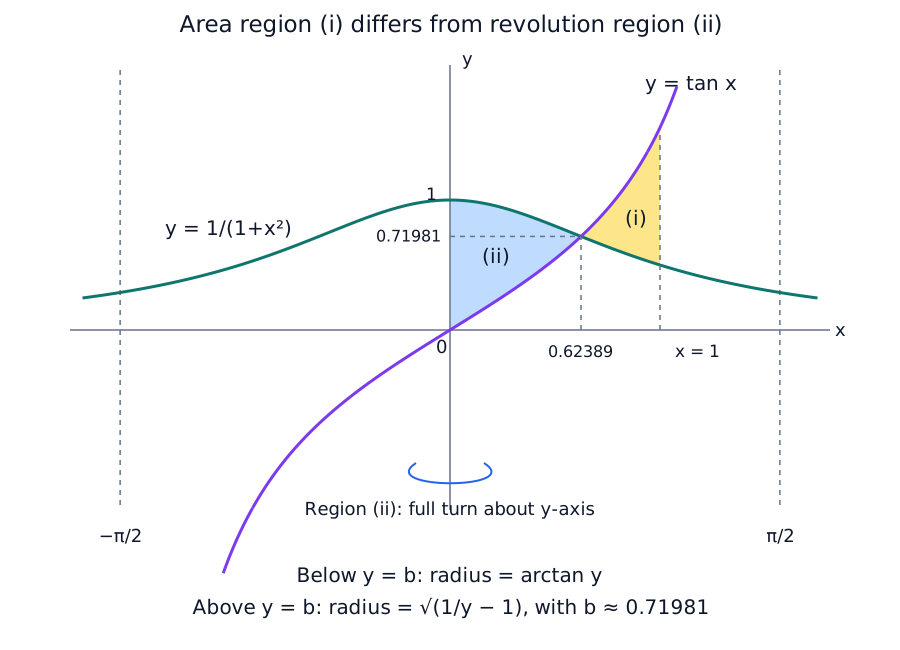
Tangent and reciprocal-quadratic curves intersect near (0.62389,0.71981). Region (i) lies between the intersection and x=1; region (ii) lies between the curves and the y-axis. The disc radius for (ii) changes from inverse tangent of y to square root of (1/y minus 1) at the intersection height.

Common mistakes

Part (i) and part (ii) use different bounded regions. Do not rotate the x=1 region for part (ii), or subtract the two y integrals as though they were inner and outer washers.

Read the hint