Porisma

Worked solution

Reuse a substitution result in a circle-area problem

(i) Using x=sin⁡θx=\sin\theta, show that ∫01/21−x2 dx=π/12+3/8\int_0^{1/2}\sqrt{1-x^2}\,dx=\pi/12+\sqrt3/8. (ii) The circle x2+(y−1)2=1x^2+(y-1)^2=1 and the line y=1−3xy=1-\sqrt3x intersect at A=(1/2,1−3/2)A=(1/2,1-\sqrt3/2). Using part (i), find the exact area of the shaded region bounded by the circle, line and x-axis.

[2018/AJC/Promo/8]

CJC · Lecture · Example 20

(i) Change variable and limits

Put x=sin⁡θx=\sin\theta, so dx=cos⁡θ dθdx=\cos\theta\,d\theta. The limits become 00 and π/6\pi/6. On this interval cos⁡θ≥0\cos\theta\ge0, so 1−sin⁡2θ=cos⁡θ\sqrt{1-\sin^2\theta}=\cos\theta and the integral is ∫0π/6cos⁡2θ dθ\int_0^{\pi/6}\cos^2\theta\,d\theta.

How did this part go?

(i) Evaluate exactly

Use cos⁡2θ=(1+cos⁡2θ)/2\cos^2\theta=(1+\cos2\theta)/2. Thus 12[θ+12sin⁡2θ]0π/6=π/12+3/8\frac12[\theta+\frac12\sin2\theta]_0^{\pi/6}=\pi/12+\sqrt3/8, as required.

How did this part go?

(ii) Choose the lower circle branch

From (y−1)2=1−x2(y-1)^2=1-x^2 obtain y=1±1−x2y=1\pm\sqrt{1-x^2}. The shaded boundary has y<1y<1, hence choose y=1−1−x2y=1-\sqrt{1-x^2}. Split the area at x=1/2x=1/2: the left piece A1A_1 is under this circle branch; the right piece A2A_2 is a triangle ending at the line intercept x=1/3x=1/\sqrt3.

How did this part go?

(ii) Add the curved piece and triangle

A1=∫01/2(1−1−x2) dx=12−(π12+38)A_1=\int_0^{1/2}(1-\sqrt{1-x^2})\,dx=\frac12-(\frac\pi{12}+\frac{\sqrt3}8). The Teacher circles and labels the triangle contribution: A2=12(13−12)(1−32)A_2=\frac12(\frac1{\sqrt3}-\frac12)(1-\frac{\sqrt3}2). Adding gives A1+A2=123−π12A_1+A_2=\frac1{2\sqrt3}-\frac\pi{12} square units, retaining the required exact answer.

How did this part go?

Compare your sketch

Expand diagram

Use the scrollbars or arrow keys to inspect details.
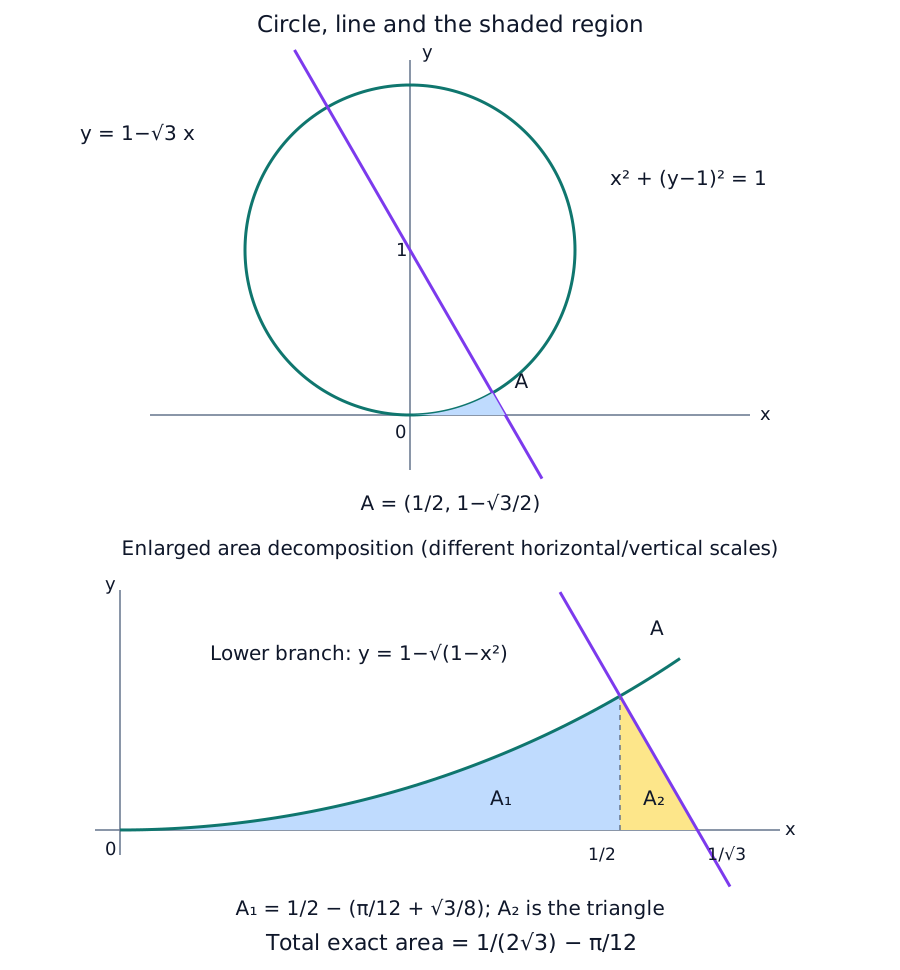
Unit circle centred at (0,1), line y=1−sqrt(3)x and shaded region touching the x-axis. A=(1/2,1−sqrt(3)/2). An enlarged area decomposition shows A1 under the lower circle branch from 0 to 1/2, followed by triangle A2 to 1/sqrt(3).

Common mistakes

Keep radicals in the line gradient, circle branch and exact answer; native text extraction loses several square-root symbols. Do not integrate the upper semicircle or replace the required exact value by a calculator decimal.

Read the hint