Porisma

Worked solution

Find the area between an exponential tangent and normal

The tangent at Q(t,et)Q(t,e^t) on y=exy=e^x meets the x-axis at TT. The normal at QQ meets the x-axis at NN. Express the area of triangle QNTQNT in terms of tt.

CJC · Lecture · Example 10

Find the tangent and its intercept

The Teacher supplies dy/dx=exdy/dx=e^x, so the tangent slope at QQ is ete^t. The tangent is y−et=et(x−t)y-e^t=e^t(x-t). Setting y=0y=0 gives x=t−1x=t-1, hence T(t−1,0)T(t-1,0).

How did this part go?

Find the normal and its intercept

The normal slope is −1/et-1/e^t, and its equation is y−et=−e−t(x−t)y-e^t=-e^{-t}(x-t). At y=0y=0, e2t=x−te^{2t}=x-t, giving N(t+e2t,0)N(t+e^{2t},0).

How did this part go?

Use a horizontal base and vertical height

The base length is NT=(t+e2t)−(t−1)=e2t+1>0NT=(t+e^{2t})-(t-1)=e^{2t}+1>0. The height above the x-axis is et>0e^t>0. Thus the area is 12et(e2t+1)\tfrac12e^t(e^{2t}+1) square units, as printed in the Teacher solution. The Student copy has the labelled diagram but blank working. No restriction on real tt is stated; the drawing’s placement of TT to the right of the origin is illustrative, not a condition t>1t>1.

How did this part go?

Compare your sketch

Expand diagram

Use the scrollbars or arrow keys to inspect details.
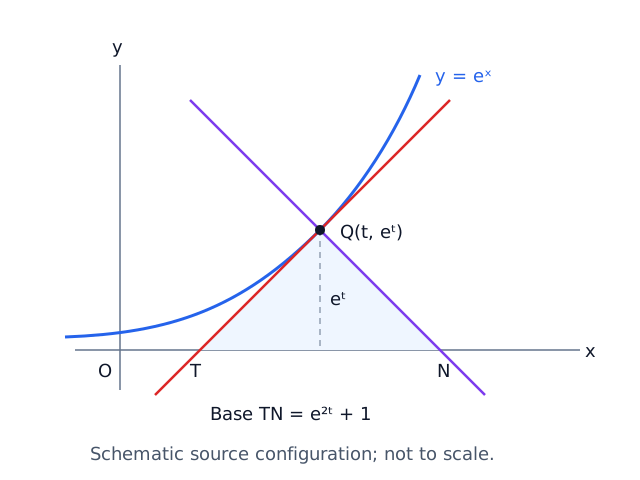
Schematic source configuration, not to scale: increasing convex exponential curve through Q(t,eᵗ), rising tangent meeting the x-axis at T, falling normal meeting it at N, with O the origin. Triangle QNT has horizontal base TN and vertical height eᵗ; the drawn ordering O,T,N is illustrative.

Common mistakes

Use the distance between T and N as the base; neither intercept alone is the base length.

Solution notes

Both source copies visually compared; printed asks and answers retained. Independent explanations are distinguished from source working.

Read the hint