Worked solution
Find the falling water level in an inverted cone
A vessel containing water has the shape of an inverted right circular cone with base radius and height . Water flows from its vertex at . Find the exact rate at which the water level is dropping when the water depth is .
CJC · Lecture · Example 13
Use the labelled similar triangles
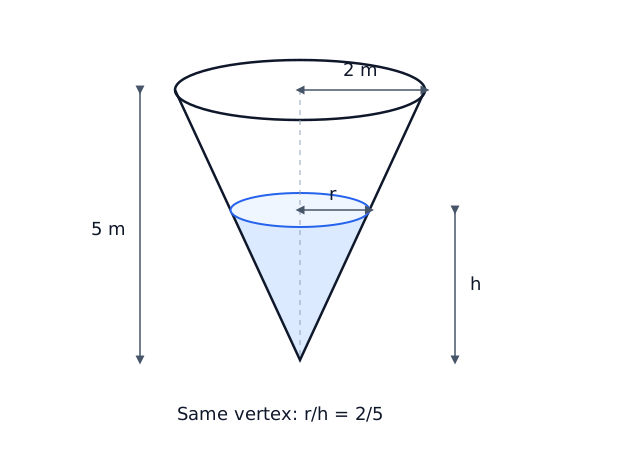
Let be the water-surface radius and its depth, both in metres. The source diagram labels the full cone radius 2 and height 5, and the changing radius r and depth h. Similar triangles give , so . Both copies advise drawing a diagram to visualise the problem; the Teacher supplies the remaining working.
Express volume in one changing variable
, so . Since water leaves the vessel, . The chain rule gives .
Separate signed change from the dropping rate
At , . Thus the water level is dropping at , the positive magnitude printed in the Teacher answer. The negative derivative records the direction of change.
Compare your sketch
Expand diagramFit diagram to page
Use the scrollbars or arrow keys to inspect details.
Common mistakes
The water radius is changing too: use similar triangles before differentiating. Outflow makes dV/dt negative.
Solution notes
Both original copies visually compared. Printed working and shared guidance retained; additional domain and verification explanations are independently authored. No marks or past-paper attribution printed.