Worked solution
Minimise metal for a cylinder with a hemispherical cap
A closed thin-metal container is a cylinder with a hemispherical cap at one end. Find the minimum area of metal required for a volume of . Given sphere volume and surface area .
CJC · Lecture · Example 14
Plan backwards from the minimum-area goal
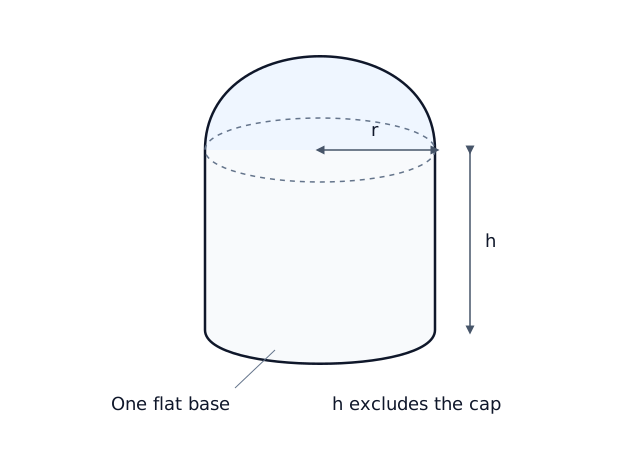
The shared source “Thinking Process” first identifies the goal: find a minimum area, locate stationary values and test their nature. The diagram has two variables, radius r and cylindrical height h. Use fixed volume to eliminate h before differentiating with respect to r; then present the volume relation, area formula, stationary calculation and minimum test in that logical order.
Use the volume constraint and count all exposed surfaces
, so . The exterior metal consists of cylinder side , curved hemisphere and one flat circular base . Hence . Do not count the internal joining circle as a second exposed base.
Find the stationary radius
. Setting this equal to zero gives , hence . This is the positive radius compatible with the physical model.
Test the minimum within the feasible domain
The Teacher gives , so the stationary area is a minimum. The shared source plan also permits a first derivative test. Independently, and imply ; the candidate is interior and gives . The area is strictly convex throughout this feasible interval, establishing the global minimum. A positive second derivative is sufficient here, not a necessary test for every minimum.
Evaluate the requested minimum area
At , , matching the Teacher answer. The Student copy prints the full planning guidance but leaves the algebraic solution blank. The shared final prompt encourages asking what is needed and how to obtain it; the sequence above follows that advice.
Compare your sketch
Expand diagramFit diagram to page
Use the scrollbars or arrow keys to inspect details.
Common mistakes
Include the curved hemisphere and the flat base; h is the cylinder’s height, not the container’s total height.
Solution notes
Both original copies visually compared. Printed working and shared guidance retained; additional domain and verification explanations are independently authored. No marks or past-paper attribution printed.