Worked solution
Derive the exponential derivative using its limiting quotient
Let . Using the first principles of differentiation, show that .
CJC · Lecture appendix · Example C
Factor out the fixed exponential
for . Thus the required auxiliary limit is .
Retain the written calculator sequence
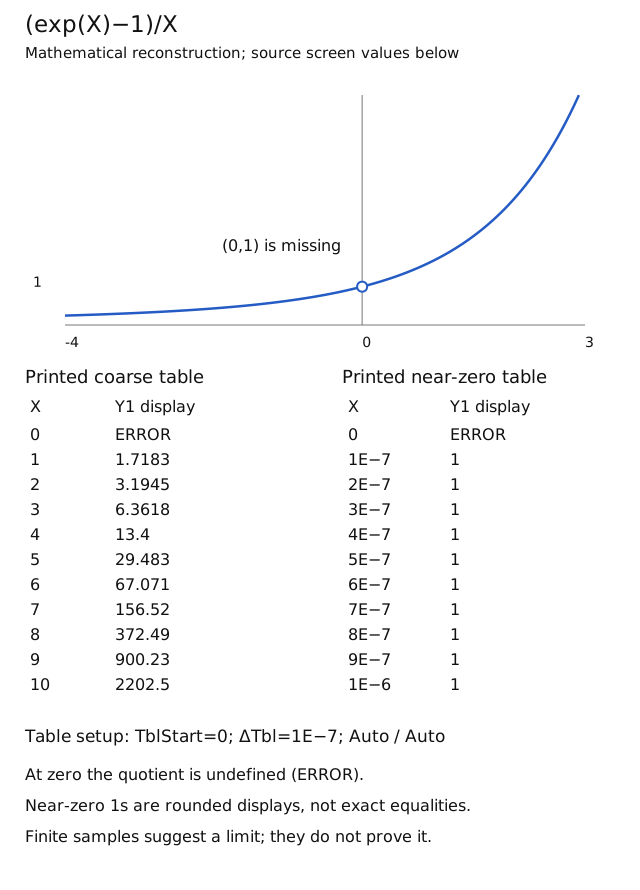
The source says Y=, enter , then GRAPH. The graph approaches height 1 near zero but does not clearly show its missing value there. 2nd → GRAPH shows ERROR at zero. Its coarse positive-input table begins approximately 1.7183, 3.1945, 6.3618 at ; these are screen approximations, not exact values.
Set up the near-zero table
The written steps and printed setup screen specify 2nd → WINDOW, TblStart=0, ΔTbl=1E−7, with independent and dependent modes both Auto. Press 2nd → GRAPH again. The source screen displays ERROR at zero and rounded values 1 at . The setup and rounded near-zero screen images are also used in the sine example: they are appropriate here because the same settings and displayed precision give the same screen contents. Displayed 1 does not mean an exact value of 1 at nonzero inputs.
Use the stated standard limit to conclude
Page 20 states that the calculator suggests . Accepting this standard limit gives for every real . Finite calculator observations motivate the limit; they are not a rigorous proof of it.
Compare your sketch
Inspect the exponential quotient near zero
1. Enter the quotient
Open Y= and enter the whole quotient using the exponential function.
- Y1
- (exp(X)-1)/X
2. Compare coarse inputs
Open TABLE with 2nd → GRAPH. The retained source displays these coarse values.
Compare coarse inputs X Y1 display 0 ERROR 1 1.7183 2 3.1945 3 6.3618 4 13.4 5 29.483 6 67.071 7 156.52 8 372.49 9 900.23 10 2202.5 3. Make the increment smaller
Press 2nd → WINDOW for TABLE SETUP. Set TblStart=0 and ΔTbl=1E−7, with independent/dependent entries on Auto. Reopen TABLE.
Make the increment smaller X Y1 display 0 ERROR 1E−7 1 2E−7 1 1E−6 1
At zero the quotient remains undefined: ERROR. The near-zero 1s are rounded displays, not exact equalities or a defined value at zero. Finite samples suggest a limit; they do not prove it. The original screens retain every intermediate table row.
View original calculator screens
Expand diagramFit diagram to page
Use the scrollbars or arrow keys to inspect details.
Common mistakes
A graph may hide an undefined input; rounded numerical values do not prove a limit.
Solution notes
Both originals print the complete appendix working. Source increments are written δx; this lesson uses h. No printed marks or past-paper attribution. Domain qualifications are independently authored. Appendix letters remain in the source label and identity; internal number 0 does not renumber them as printed numbered examples.