Worked solution
Distinguish vertical and horizontal line tests
State and justify which of the following is a one-to-one function. (a) , , . (b) , , .
CJC · Functions · Example 4
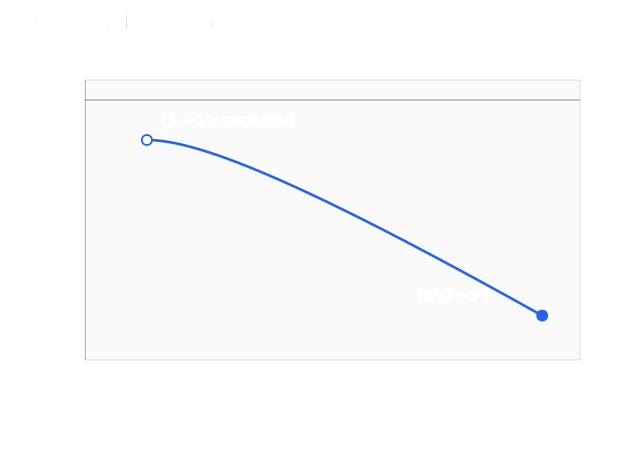
(a) Each attained output identifies one input
Answer
f is one-to-one.
The Teacher states that every horizontal line y=k meets the graph at most once. Independently throughout the allowed interval, so strict decrease proves this globally. Keep the open point at 1 and included point at e².
Expand diagramFit diagram to page
Use the scrollbars or arrow keys to inspect details.
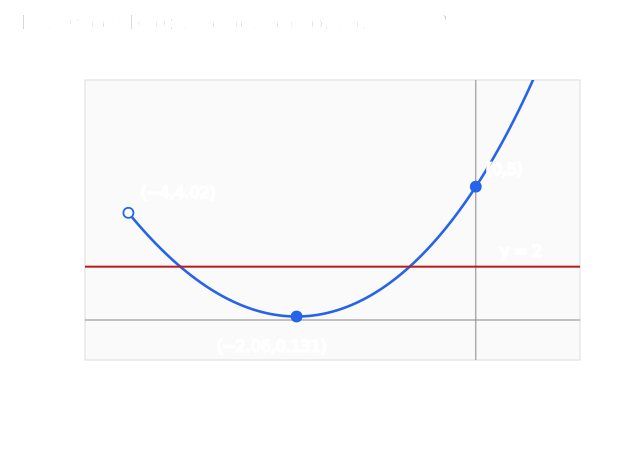
(b) Find a repeated output
Answer
g is not one-to-one.
The Teacher adds the line y=2, which meets both sides of the minimum. Independently the minimum is below 2, the left boundary limit is , and . Continuity and strict decrease/increase on the two sides give one input for y=2 on each side, so two distinct allowed inputs share an output.
Expand diagramFit diagram to page
Use the scrollbars or arrow keys to inspect details.
Solution notes
The same curves are deliberately reused for a new ask: existence as a function and existence as an inverse use different line tests. Source outlines refer strict monotonicity to Applications of Differentiation.