Worked solution
Choose an injective restriction without hiding ambiguity
Given that , , . Show that is not one-to-one. A function is a restriction on ; state the largest possible domain of , for which is one-to-one.
CJC · Functions · Example 5
Show that f is not one-to-one
Answer
f is not one-to-one.
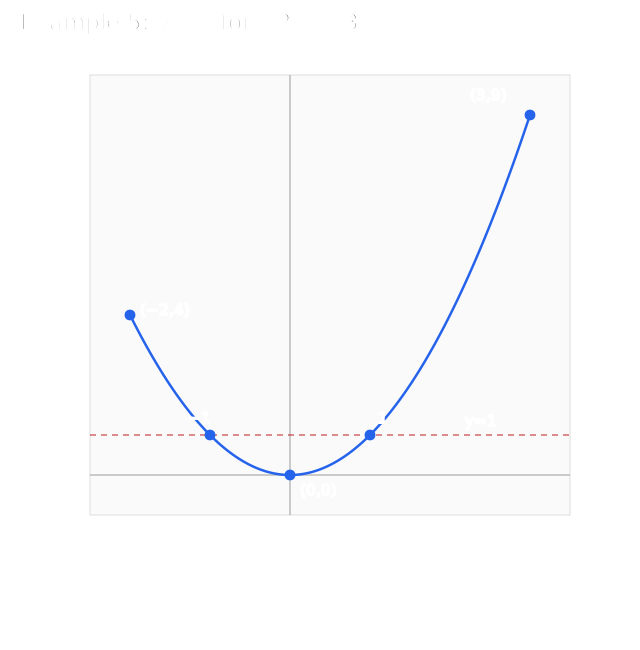
The Teacher draws the full restricted parabola with included endpoints and , and the line . That line meets it twice: independently with two distinct permitted inputs. One counterexample disproves injectivity.
Expand diagramFit diagram to page
Use the scrollbars or arrow keys to inspect details.
State the source restriction and its qualification
Answer
The Teacher selects . This is the longest interval restriction; “largest” without a criterion is ambiguous.
On , squaring is strictly increasing, so the Teacher’s selected restriction is one-to-one. Independently the other inclusion-maximal interval is , where squaring is strictly decreasing. Any interval containing both a negative and a positive input contains a small pair and is not injective. Thus has the greater interval length, 3 rather than 2. Under set inclusion neither of those two maximal intervals contains the other, so no unique greatest injective domain exists. If arbitrary non-interval subsets are permitted, further maximal choices can select one sign from each pair. Keep the printed ask and answer with this qualification rather than silently adding an interval/length condition to the prompt.
Solution notes
The ambiguity was already recorded in evidence/cjc-functions-inverse-review.md; this import retains it explicitly. No printed marks or external exam attribution.