Porisma

Worked solution

Use the original domain to choose the inverse branch

Let ff be the function defined by f:x↦x2−1f:x\mapsto x^2-1, x∈Rx\in\mathbb R, x<0x<0. Define f−1f^{-1} in a similar form.

CJC · Functions · Example 7

Reject the positive root

Answer

f−1:x↦−x+1f^{-1}:x\mapsto-\sqrt{x+1}, x∈Rx\in\mathbb R, x>−1x>-1.

The Teacher’s full chain is y=f(x)y=f(x), y=x2−1y=x^2-1, x2=y+1x^2=y+1, x=±y+1x=\pm\sqrt{y+1}. Reject +y+1+\sqrt{y+1} because the original input satisfies x<0x<0, leaving f−1(y)=−y+1f^{-1}(y)=-\sqrt{y+1}. The original graph is the left branch of the shifted parabola with an open point (0,−1)(0,-1); its range is (−1,∞)(-1,\infty). Therefore Df−1=Rf=(−1,∞)D_{f^{-1}}=R_f=(-1,\infty), and renaming y gives the stated rule with domain. The source reminder requires both rule and domain when defining a function. Independently its inverse range is (−∞,0)(-\infty,0); the boundary x=−1 is excluded, so the inverse never outputs 0.

Expand diagram

Use the scrollbars or arrow keys to inspect details.
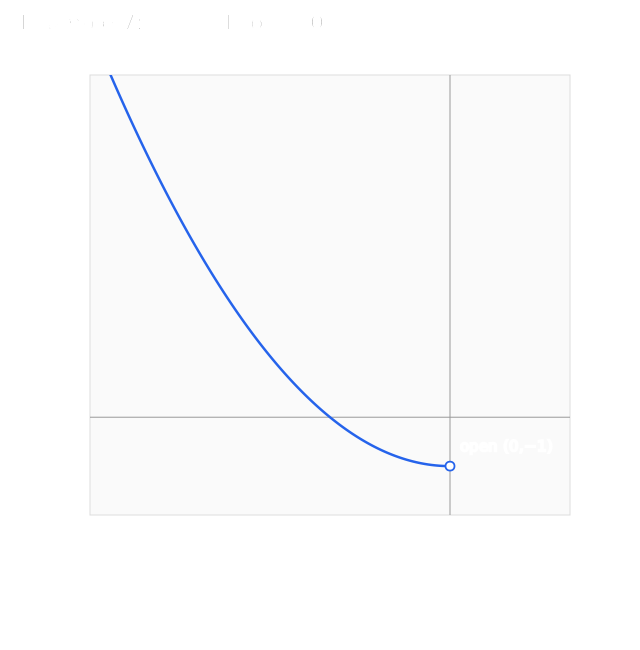
Original left branch y=x²−1 for x<0, hollow endpoint(0,−1), decreasing as x approaches 0. Original range (−1,∞) becomes the inverse domain.
How did this part go?