Worked solution
Reflect an exponential graph to define the logarithm
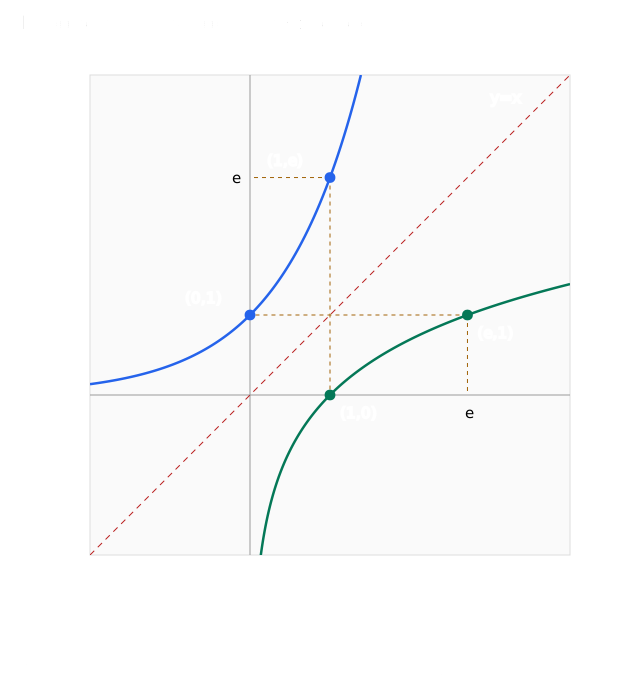
Let be a function defined by , . (i) Define in a similar form. (ii) On a single diagram, sketch , and .
CJC · Functions · Example 8
(i) Reverse exponentiation
Answer
, , .
The Teacher writes , , , so . Since , . Rename the input and give the rule together with that domain. Independently the inverse range is all real numbers.
(ii) Sketch the reflected pair
Answer
The graphs and reflect in , with intercepts and and asymptotes and .
The Teacher completes all three curves, labels the two intercepts, the horizontal asymptote of the exponential and the vertical asymptote of the logarithm. Use equal unit scales on both axes so reflection in is geometrically correct. The later source illustration also shows and its reflected point ; these are included in the same reconstruction with dashed coordinate guides. In general becomes , horizontal asymptotes become vertical, and vertical become horizontal. Draw to show the relationship even when a sketch question does not request that reference line explicitly.
Expand diagramFit diagram to page
Use the scrollbars or arrow keys to inspect details.