Worked solution
Find exact intercepts and verify the calculator window
Find the coordinates of the axial intercepts of the curve .
CJC · Lecture · Example 1
Find the exact intercepts algebraically
Set : , giving or . Set : . The axial intercepts are , and .
Find each zero using the calculator
The source gives six steps.
-
Press Y= and enter into Y1.
-
Press 2nd → TRACE, then CALCULATE → 2:zero.
-
Set a left bound to the left of the first root, using the arrows and ENTER or entering a number.
-
Set a right bound to its right. The bounds should contain only one root, or the calculator may return the other.
-
For Guess?, move near that root and press ENTER.
-
Repeat steps 2–5 for the other root.
The displayed zeros are and . A numerical result such as must be checked before rounding: substitution of gives .
Change the window before finding the y-intercept
The source gives five further steps.
-
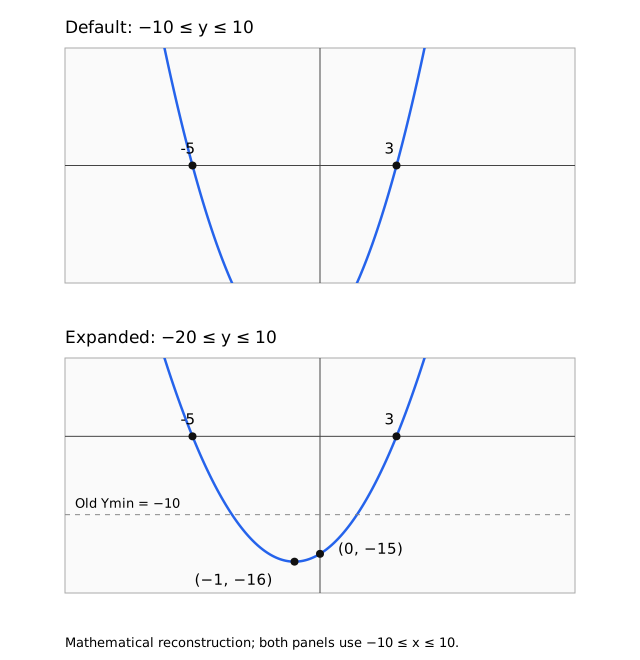
Press WINDOW; the illustrated defaults are Xmin=, Xmax=, Ymin=, Ymax=.
-
Set Ymin=. Window selection is a trial-and-error process; there is no single required window.
-
Press GRAPH to display the previously clipped minimum.
-
Press 2nd → TRACE, then CALCULATE → 1:value.
-
Enter 0 → ENTER to obtain .
Independently, completing the square gives , so the minimum explains why the original Ymin hides it. The reconstruction compares these two windows.
Choose a method suited to the requested precision
Both copies explicitly require algebraic/analytical working when exact coordinates are requested. When using the calculator, use its zero/value routines; moving along the curve with arrow keys and simply reading coordinates is not accurate enough. The graph supports the calculation, while algebra proves the exact values.
Compare your sketch
Expand diagramFit diagram to page
Use the scrollbars or arrow keys to inspect details.
Common mistakes
A clipped display does not remove the minimum or the y-intercept; verify approximate zeros before rounding them.
Solution notes
Both Student and Teacher originals compared. Printed answers retained; independent explanations identified in the working. No printed marks or external attribution.