Worked solution
Use long division for an oblique asymptote
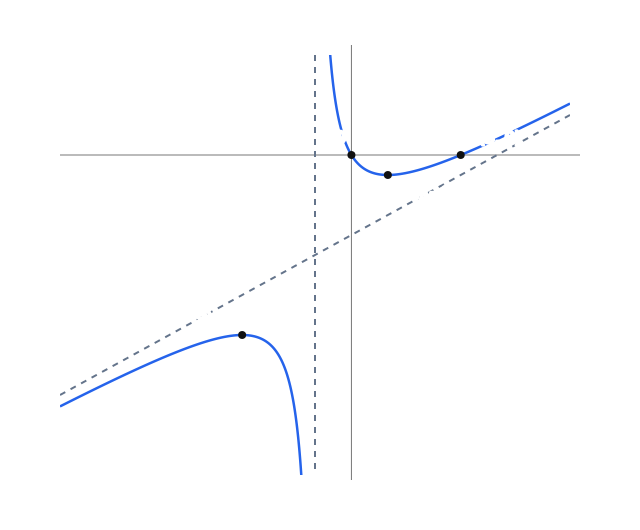
Given the curve , find the equations of the asymptotes and sketch the curve.
CJC · Lecture · Example 3
Retain the vertical restriction
The source identifies as undefined. Independently the numerator there is ; the quotient is unbounded as approaches , so is a vertical asymptote.
Carry out the Teacher long division
The Teacher annotation divides by : quotient term , subtract to leave ; next quotient term , subtract to leave remainder . Therefore The printed shorthand says . Precisely, as , so is the oblique asymptote.
Preserve the complete source sketch
The source labels the origin, , the maximum and minimum . The Teacher copy adds dashed and . Independently, supplies the intercepts, and vanishes at . Its sign changes at and at , verifying the printed turning points. The left branch is below its oblique line and tends to at ; the right lies above it and tends to at . Example 4 next develops turning-point methods in detail; its full continuation remains separate.
Compare your sketch
Expand diagramFit diagram to page
Use the scrollbars or arrow keys to inspect details.
Common mistakes
For a sloping asymptote, show the difference tends to zero; the function does not tend to a finite value of x−4.
Solution notes
Both original copies visually compared. Independent checks and qualifications are identified in the working. No printed marks or external attribution.