Worked solution
Find exact input and output ranges
Find the range of values of and for the following curves:
(a) .
(b) .
(c) .
CJC · Lecture · Example 5
Answer
(a) , . (b) , . (c) ; or .
(a) Logarithmic input and output ranges
Answer
, .
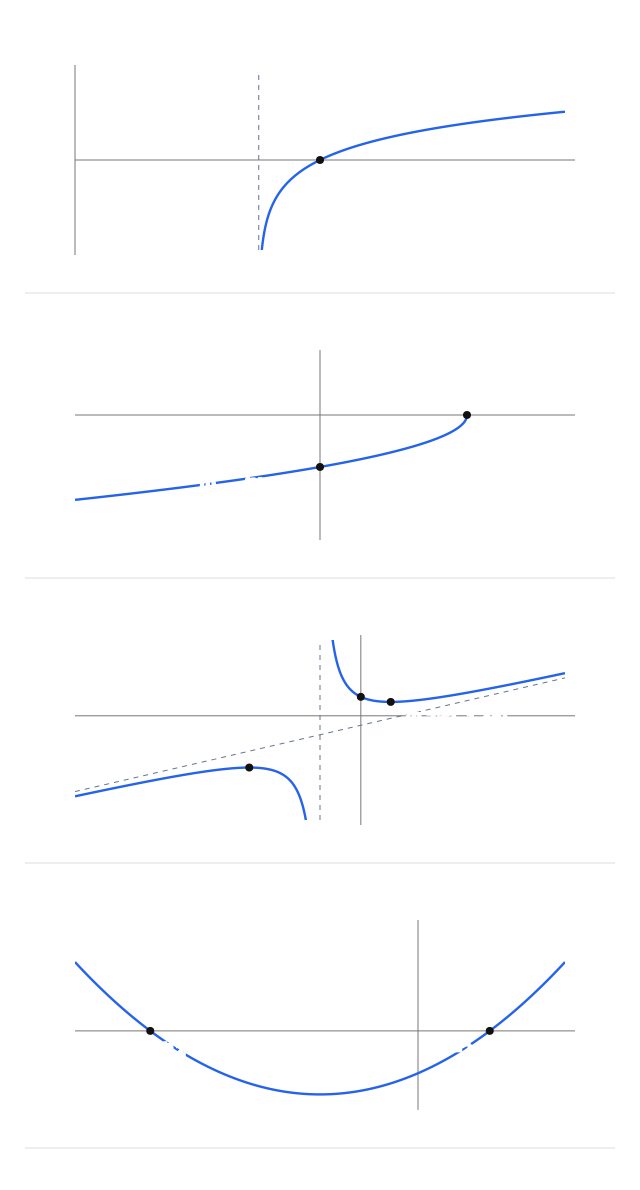
The source requires , hence . Its graph labels vertical asymptote and intercept , and gives . Independently, for every real , the input gives that output; this proves the full range rather than just suggesting it from a window.
(b) Keep the negative square-root branch
Answer
, .
The printed curve is , with the radical over the whole . Require , so . The source graph labels and ; its range is . Independently, for every , choose to recover . The endpoint is included.
(c) Keep the original excluded input
Answer
.
For , the source gives , or or . At the excluded input the numerator is , so this is not a removable cancellation.
(c) Use the Teacher-completed quadratic formula
The Teacher completes the Student working space. Starting from
write . The printed quadratic-formula chain is
For real , its discriminant must be nonnegative. This gives an exact algebraic condition on the possible outputs.
(c) Solve the exact output condition
Answer
or .
The Teacher gives and solves the boundary equation:
Its upward parabola shows that the required values lie outside the roots, including the roots: or . Independently, the recovered quadratic has value at for every , so no recovered root is the excluded input. Thus the discriminant condition is sufficient as well as necessary, and both endpoints are attained.
(c) Compare exact endpoints with the printed sketch
The shared graphical method is labelled for non-exact answers. It labels , , , maximum and minimum , then reports or . Retain these as rounded readings, not exact boundary inequalities.
Independently, division gives and . The exact turning inputs are , with ordinates . They agree with the source’s rounded labels. The source recommends using known input/output restrictions to choose Xmin, Xmax, Ymin and Ymax so relevant graph features can be seen; a finite display cannot literally show an unbounded whole curve.
Compare your sketch
Expand diagramFit diagram to page
Use the scrollbars or arrow keys to inspect details.
Common mistakes
The radical covers 3−x. Do not replace exact range endpoints by rounded graph readings, and retain the original denominator restriction.
Solution notes
Both original copies visually compared: Teacher completes the algebra and discriminant/parabola working absent from the visible Student layout. Native extraction is retained unchanged even where it contains hidden Student text. No printed marks or external attribution.