Worked solution
Sketch products and quotients involving exponentials
Sketch the graph of the following curves, indicating clearly the coordinates of any intersections with the axes, turning points and the equations of any asymptotes:
(a) .
(b) .
CJC · Lecture · Example 8
Answer
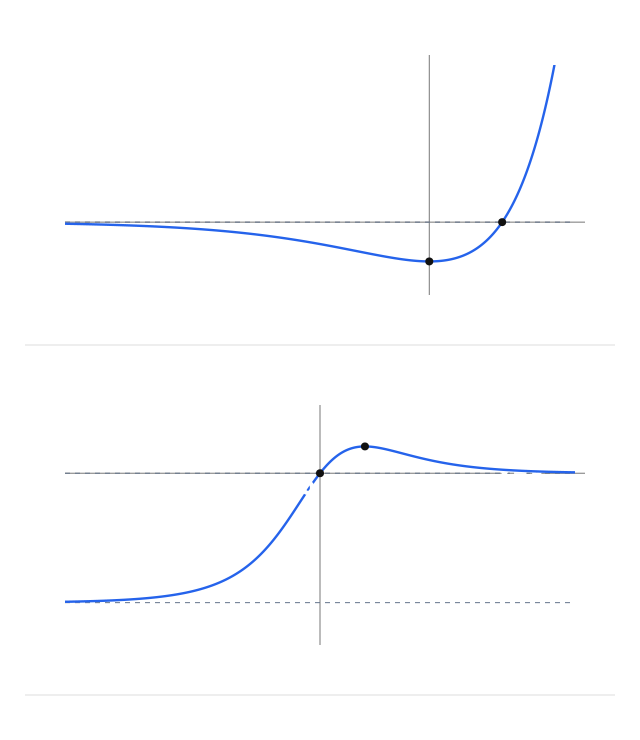
(a) Intercepts and ; minimum ; horizontal asymptote as . (b) Intercept ; maximum ; horizontal asymptotes as and as . Neither curve has a vertical asymptote.
(a) Check the product at the infinite end
The Teacher completes the blank Student asymptote working with , and , giving horizontal asymptote . Independently, the inference needs the whole product: writing gives . It approaches from below. As the curve grows without bound. Its domain is all real , with no vertical asymptote.
(a) Locate and classify the minimum
Answer
Minimum .
The source gives and , hence and . The Teacher supplies
Independently , so the derivative changes from negative to positive at ; the stationary point is the minimum. The Teacher recommends demonstrating with TI-SmartView, showing differentiation if time permits, or using the graphing calculator to find the turn. In this lesson, predict the shape and use a calculator minimum search as a check, then compare with the exact derivative test.
(b) Take the left limit directly
The denominator is positive for every real input. As , , so . Thus is a horizontal asymptote on the left. The Teacher adds the curve and asymptote labels to the visible Student blank graph.
(b) Resolve the indeterminate quotient before taking a limit
Both sources warn that the formal expression is not a limit value. Their complete manipulation divides numerator and denominator by :
Now gives , so is a horizontal asymptote on the right. For the intercepts, gives , while requires , hence . Both axes meet the curve at the origin.
(b) Check the calculator maximum with an exact derivation
The printed instruction is “Use G.C.”; the Teacher sketch labels a maximum . Independently let , so
Only is positive. The derivative changes there, giving the exact maximum . This agrees with the source’s rounded calculator labels. There is no minimum: , while the lower limit is approached only as .
Compare the two ends in a calculator table
The next source page gives this five-step procedure for the same quotient:
- Enter into Y₁, keeping both full numerator and denominator grouped.
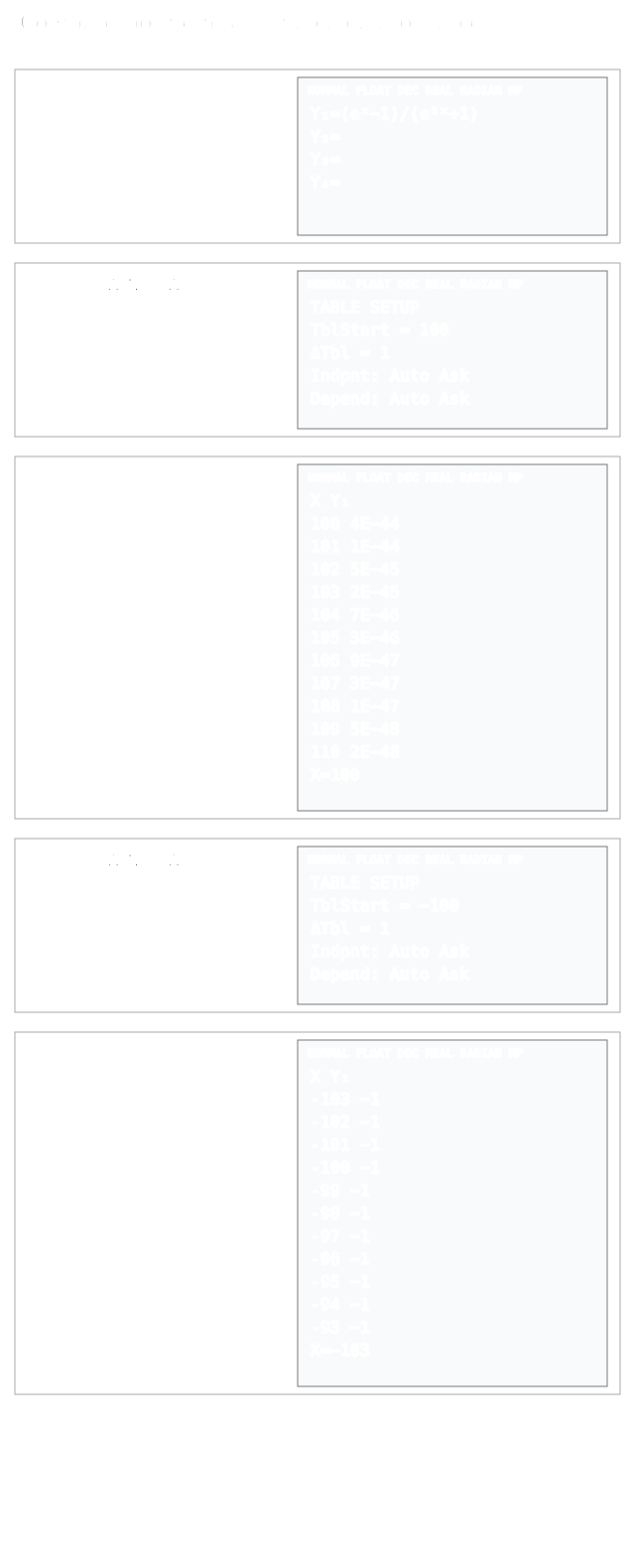
- Press 2nd → WINDOW to open TBLSET. Set TblStart to a large positive value, such as 100. ΔTbl is the increment (default 1); the screenshot uses automatic independent/dependent values.
- Press 2nd → GRAPH for TABLE, then inspect increasing inputs. The source table for displays tiny positive values (about down to ), suggesting at the right end.
- Return with 2nd → WINDOW and set TblStart to a large negative value, such as −100.
- Use 2nd → GRAPH and inspect decreasing inputs. The source display at approximately −103 through −93 rounds the outputs to −1, suggesting the left asymptote .
The Teacher describes this as a way to guess asymptotes. Finite tables and rounded entries are evidence for a conjecture, not proof that a value is reached or an end limit exists. Use the preceding algebraic limits to justify both asymptotes. A displayed −1 is rounded: independently for .
Compare both ends with a calculator table
1. Enter the full quotient
Open Y= and put parentheses around both the numerator and denominator.
- Y1
- (e^X-1)/(e^(2X)+1)
2. Inspect large positive inputs
Press 2nd → WINDOW for TBLSET. Set TblStart=100 and ΔTbl=1, with Indpnt and Depend on Auto. Press 2nd → GRAPH for TABLE. These selected source readings are small positive values.
Inspect large positive inputs X Y1 display 100 4E−44 106 9E−47 110 2E−48 3. Compare large negative inputs
Return to TBLSET with 2nd → WINDOW. Change TblStart to −100, keeping ΔTbl=1 and both Auto settings. Reopen TABLE and scroll to inspect decreasing inputs.
Compare large negative inputs X Y1 display −103 −1 −100 −1 −93 −1 4. Justify the two asymptotes
The displays suggest y=0 on the right and y=−1 on the left. Use the algebraic limits in the working to justify each end separately.
The negative-input readings round to −1; the curve does not reach −1 at any finite input. Finite tables suggest a limit but do not prove it. The original screens retain every intermediate row.
View original calculator screens
Expand diagramFit diagram to page
Use the scrollbars or arrow keys to inspect details.
Compare your sketch
Expand diagramFit diagram to page
Use the scrollbars or arrow keys to inspect details.
Common mistakes
An exponential tending to zero does not by itself settle its product with an unbounded factor. Likewise ∞/∞ is indeterminate, and horizontal asymptotes may differ at opposite ends.
Solution notes
PDF/printed pages 17–18 compared in both copies. Teacher completes part (a), adds both plotted curves and labels, and recommends calculator demonstration with optional differentiation. Part (b) algebra/intercepts are already visible in Student; the maximum label is Teacher-completed. Exact maximum derivation is independently added. No printed marks or external attribution.
The calculator-table continuation on PDF/printed page 19 is retained in the shared native transcript for 19–22; both original versions visually compared. Teacher-only “guess” guidance is integrated in that working part.