Worked solution
Sketch rational curves from division and domain
Sketch the graph of the following curves, indicating clearly the coordinates of any intersections with the axes, turning points and the equations of any asymptotes:
(a) .
(b) .
(c) .
(d) .
(e) .
CJC · Lecture · Example 9
Answer
(a) Asymptotes ; intercepts ; no turns.
(b) Asymptotes ; intercepts ; local minimum .
(c) Asymptotes ; sole intercept ; local maximum , local minimum .
(d) Asymptotes ; intercepts ; no turns.
(e) Asymptotes ; sole intercept and local minimum ; local maximum .
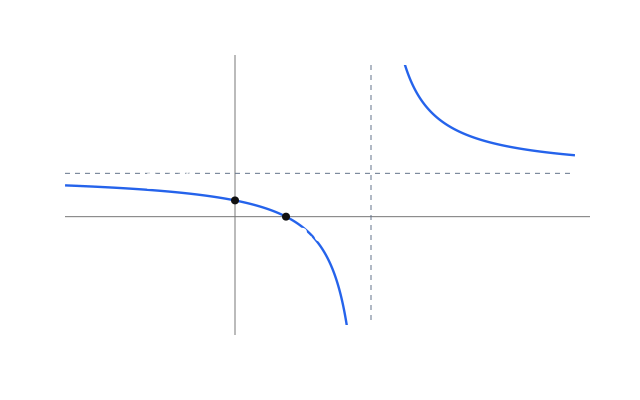
(a) Translate the reciprocal graph
Answer
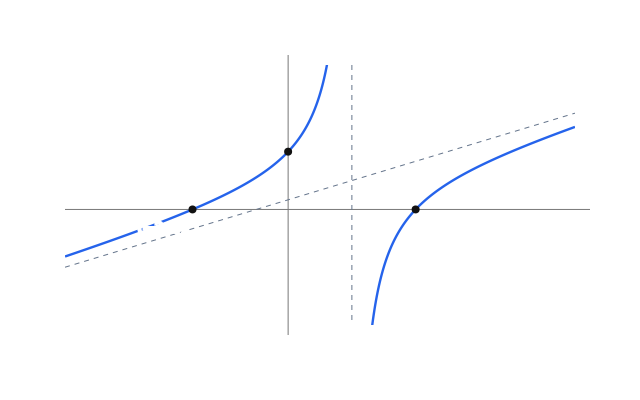
Asymptotes ; intercepts ; no turns.
Both sources give
The asymptotes are and ; intercepts follow from and . The Teacher adds labels to the existing Student curve. The source says there are no stationary points; independently on each domain branch. The numerator at is nonzero, so this is a pole, not a hole.
Expand diagramFit diagram to page
Use the scrollbars or arrow keys to inspect details.
(b) Separate three continuous branches
Answer
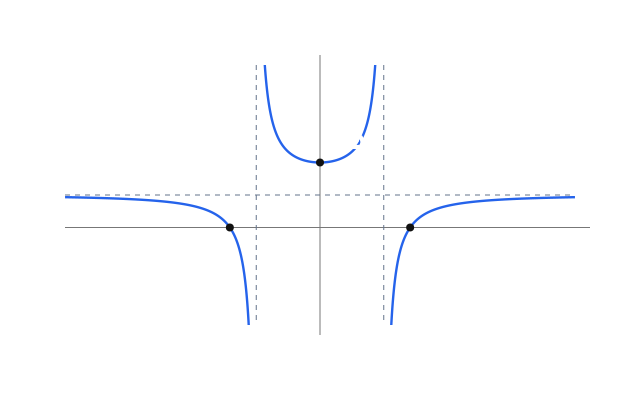
Asymptotes ; intercepts ; local minimum .
The printed division chain is
Asymptotes are and . Substituting gives ; solving gives . The Teacher completes the graph labels and the missing left vertical asymptote in the visible Student sketch. “Use G.C.” is the printed stationary-point instruction. Independently
On the central branch the derivative changes at 0, so is a local minimum; neither exterior branch has a stationary point. It is not a global minimum over the disconnected domain. Both denominator zeros are genuine poles.
Expand diagramFit diagram to page
Use the scrollbars or arrow keys to inspect details.
(c) Divide before finding the two turns
Answer
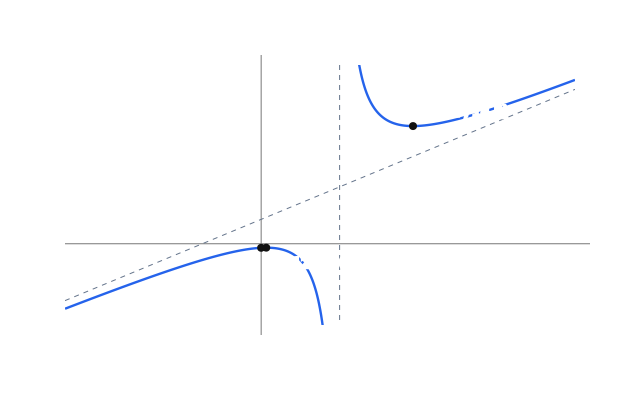
Asymptotes ; sole intercept ; local maximum , local minimum .
The Teacher completes the Student blanks with
Its asymptotes are and . At , . The equation has no real solutions (independently its discriminant is ), so there are no -intercepts. The source asks for G.C. stationary points and labels a maximum and minimum in the Teacher graph. Independent calculus gives
The minus signs give the left local maximum; the plus signs give the right local minimum. The original pole at 2 separates them. Keep the exact expressions for calculation and treat the printed decimals as rounded.
Expand diagramFit diagram to page
Use the scrollbars or arrow keys to inspect details.
(c) Inspect the window and a zoomed maximum
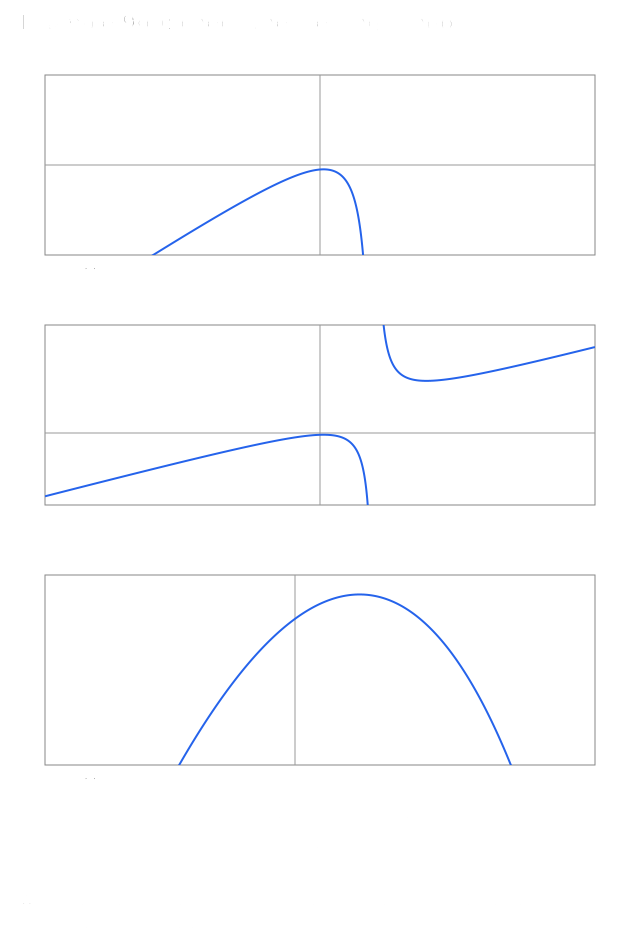
The source compares ZOOM 6: ZStandard with adjusted window settings: the standard view misses the right-hand branch, while the adjusted view shows both sides of . A finite view can show relevant features, never literally all of an unbounded graph. It also warns that the left maximum may seem to lie on the -axis. Use ZOOM 1: ZBox to enlarge that region. The source maximum screen reports approximately and , not . Independently the exact left-turn input is ; at the curve is still increasing, with derivative .
Expand diagramFit diagram to page
Use the scrollbars or arrow keys to inspect details.
(d) A slant asymptote without turning points
Answer
Asymptotes ; intercepts ; no turns.
The Teacher fills the visible Student blanks:
The asymptotes are and . At , ; setting gives and . The source says no stationary points. Independently on each branch, so the curve is increasing on each side of the pole, with no turns.
Expand diagramFit diagram to page
Use the scrollbars or arrow keys to inspect details.
(e) Keep both poles and the double zero
Answer
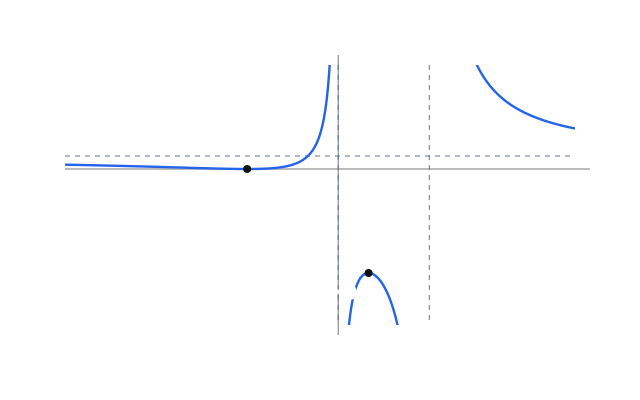
Asymptotes ; sole intercept and local minimum ; local maximum .
Both sources give
Thus is the horizontal asymptote and are vertical asymptotes. At the function is undefined, so there is no -intercept. The only -intercept is , where the squared numerator gives contact. The printed instruction is “Use G.C.”; the Teacher graph also labels . Independently
Its sign gives a local minimum on the left branch and a local maximum on the central branch. On the far-right branch the derivative is negative, with no turn. Neither turn is a global extremum over all three branches.
Expand diagramFit diagram to page
Use the scrollbars or arrow keys to inspect details.
(e) Reject the false limit suggested by a standard screen
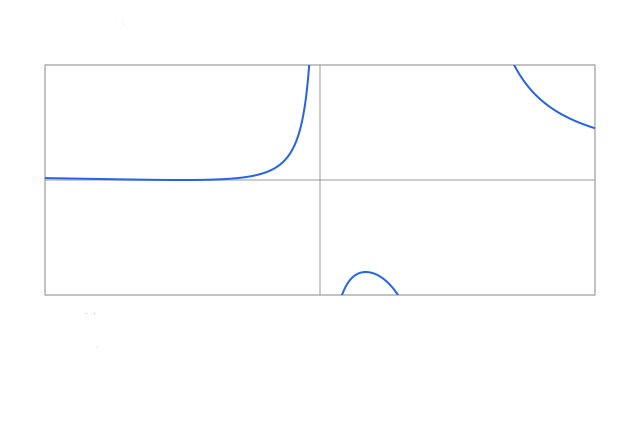
The shared source warning says ZOOM 6: ZStandard does not clearly show the curve, and the left tail may appear to approach 0. This is false: the division form shows as , since . Determine asymptotes and intercepts analytically before using a calculator for shape. The Teacher also recommends showing long division if needed; compare each numerator with denominator × quotient + remainder before plotting.
Expand diagramFit diagram to page
Use the scrollbars or arrow keys to inspect details.
Common mistakes
A standard window can hide a branch, disguise a turning input, or suggest a false asymptote. A denominator zero must be checked against cancellation before calling it a vertical asymptote.
Solution notes
Both originals visually compared on 20–22. Teacher completes(c)/(d), labels (a)/(b), adds(e) sketch and long-division guidance. “Use G.C.” is preserved; exact derivative classifications are independent supplements. No printed marks or external attribution.