Worked solution
Recover parameters and check the complete curve
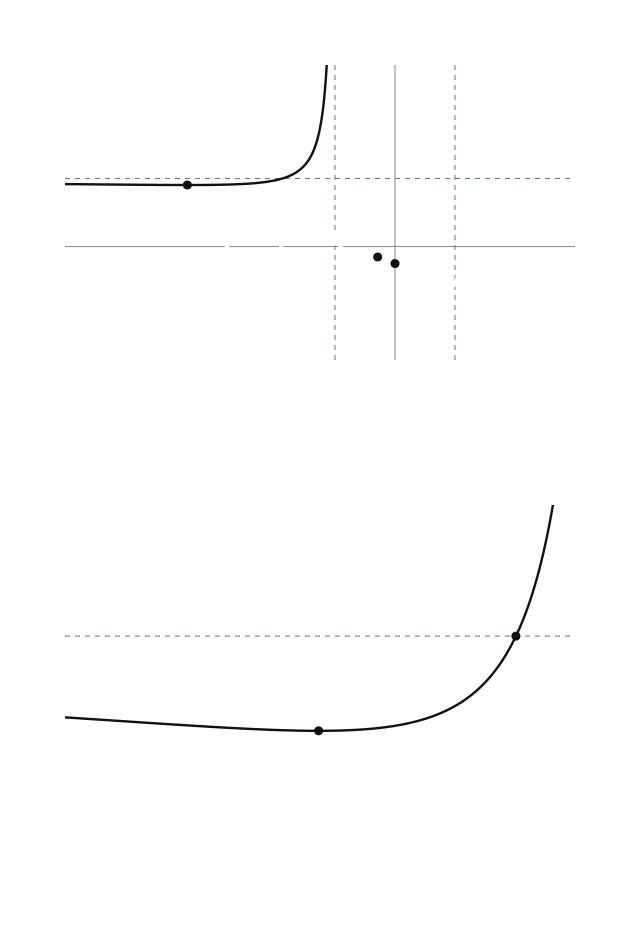
The curve has an equation where and are constants.
(i) Given that two of the asymptotes of are and , determine the values of and .
(ii) Sketch the curve , giving the coordinates of the point(s) where the curve crosses the axes, stationary points and the equations of all asymptotes.
2019/CJC/Promo/2
CJC · Lecture · Example 11
Answer
(i) . (ii) Asymptotes ; sole axial intercept . Local minimum and local maximum .
(i) Use the given vertical asymptote
Answer
.
The Teacher completes the Student working with
Independently, a genuine vertical asymptote at 2 requires the original denominator to vanish there, so . After finding below, also check the numerator at both denominator zeros to rule out removable holes.
(i) Use the quotient and retain the long-division stages
Answer
.
With , the source division has leading term . Multiplying back gives ; subtracting from leaves . Hence
The remainder tends to 0 at either infinite end, giving horizontal asymptote . The given therefore gives . This retains the Teacher’s full subtraction/remainder argument, not just its result.
(ii) Establish the asymptotes and intercepts
Substitution gives . Both source sketches label and . Independently the numerator is 7 at −2 and 23 at 2, so both vertical asymptotes are genuine. Its discriminant is , hence there is no -intercept. The -intercept is .
(ii) Check the turning point outside the source sketch
Both source sketches label only the central local maximum . Independent differentiation finds two stationary points over the full domain:
The roots are . The far-left root gives a local minimum near ; the other gives the source-labelled maximum near . Exact ordinates are respectively and . Derivative signs are at the first root and at the second, splitting at the poles as required.
The source drawing does not display the far-left turn or crossing of the horizontal asymptote. Independently vanishes at and tends to 0 from below as . A horizontal asymptote may be crossed. The complete reconstruction includes these features; the original source excerpt and its labelled maximum are preserved in review evidence.
Expand diagramFit diagram to page
Use the scrollbars or arrow keys to inspect details.
Common mistakes
The source sketch does not show every stationary point. Do not infer that a horizontal asymptote cannot be crossed.
Solution notes
Printed attribution 2019/CJC/Promo/2 is retained separately from the prompt; no marks are printed. Teacher completes part (i), while both copies already show the same part (ii) sketch. The far-left stationary point and horizontal-asymptote crossing are independently added, with original evidence retained.