Worked solution
Read polynomial roots as intersection inputs
The curve has equation .
(i) Determine the asymptotes of .
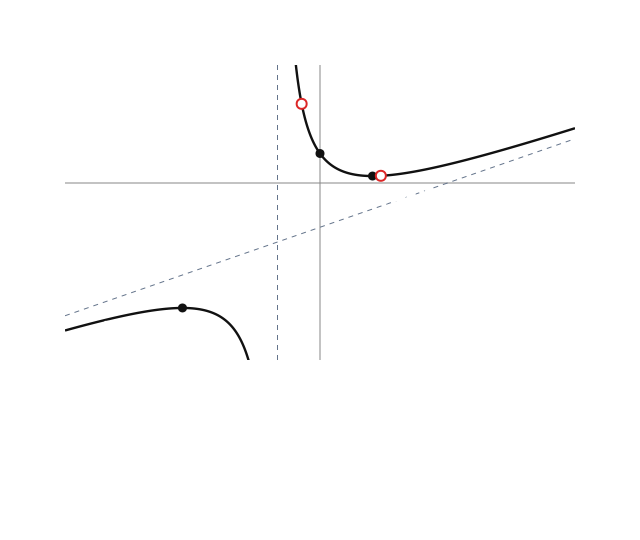
(ii) Sketch , showing clearly any axial intercepts, turning points and asymptotes.
(iii) Deduce the number of real roots of the equation .
CJC · Lecture · Example 12
Answer
(i) and . (ii) Sole axial intercept ; local maximum and local minimum . (iii) Two real roots.
(i) Preserve the division and remainder
Answer
, .
Both copies show quotient : subtract from the numerator to leave , then subtract to leave 5. Thus
The source asymptotes are and . Independently the numerator at −1 is 5, so the vertical asymptote is genuine.
(ii) Match exact features with the printed rounded coordinates
Both sketches label , local maximum and local minimum . Independently the numerator has no real zero, so there is no -intercept. Differentiating the division form gives
The minus pair is the left local maximum; the plus pair is the right local minimum. Their exact values agree with the rounded source labels. The label in the combined source picture belongs to the axis/reference curve; it is not a horizontal asymptote of .
(iii) Preserve the algebra linking the two graphs
Answer
Two real roots.
The Teacher completes the blank Student working with
Sketch on the same axes. The Teacher adds that blue curve and marks its two intersections with , giving two real roots. Its lecturer note stresses that the x-coordinates of the intersection points solve the original equation; the plotted ordinates are not the roots.
Independently the rearrangement excludes , but neither solves the quartic: its values there are −1 and 5. Thus no original root is lost and no excluded input is promoted.
Expand diagramFit diagram to page
Use the scrollbars or arrow keys to inspect details.
Verify that the sketch has not missed further roots
Independent check: let . Then
Its derivative is strictly increasing, so decreases then increases and has at most two real zeros. Since , and , continuity gives one zero in and one in . These are exactly the two graph intersections. This verifies the source count without treating a finite screen as proof.
Common mistakes
Intersection ordinates are not polynomial roots. Distinguish the reference curve’s asymptote y=0 from C’s slant asymptote.
Solution notes
Teacher completes part (iii), adds reference curve/intersection marks and the x-coordinate teaching note. All source algebra, long division and rounded graph labels retained. No printed marks or external attribution.