Worked solution
Combine an algebraic range with an intersecting line
The curve has equation , , .
(i) Using an algebraic method, find the range of values that can take.
(ii) Sketch , stating the equations of the asymptotes, axial intercepts and the coordinates of the turning points, if any.
(iii) State the range of values that can take such that the equation has 2 distinct solutions, justifying your answer.
2018/RI/Promo/9
CJC · Lecture · Example 13
Answer
(i) or . (ii) Asymptotes , ; intercepts and ; local maximum and local minimum . (iii) .
(i) Apply the discriminant to the quadratic in x
Answer
or .
The Teacher completes the Student blanks with the full chain
For a real input, the discriminant is nonnegative:
Thus or . Independently, substituting the forbidden input 2 into the recovered quadratic gives 9 for every , so a recovered root can never be 2. The discriminant condition is sufficient too; both endpoints are attained at the turning points below.
(ii) Read and verify the source graph
Both copies give
and label asymptotes , , turns , -intercept , and rounded -intercepts −3.30 and 0.303. Independently solving gives exact roots ; substituting 0 gives . Derivative changes at −1 and at 5, verifying the local maximum/minimum and the range endpoints. The numerator at 2 is 9, so the pole is genuine.
Expand diagramFit diagram to page
Use the scrollbars or arrow keys to inspect details.
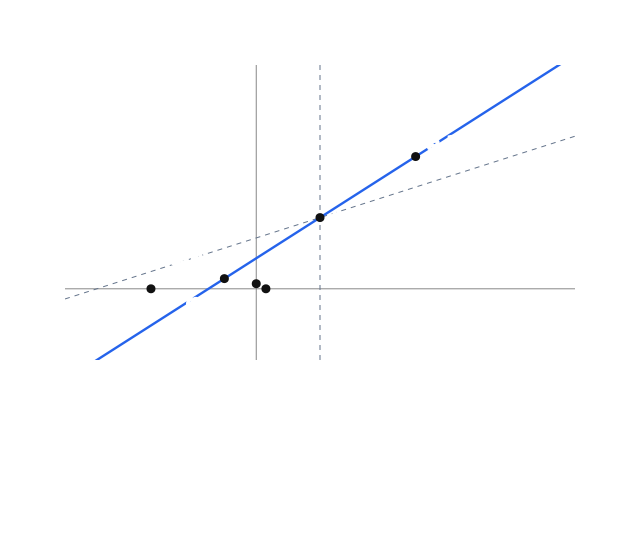
(iii) Use the line through the asymptote intersection
Answer
.
The source line is , so every member passes through with gradient . This point is the intersection of ’s two asymptotes, not a point on . To meet both branches in two distinct points, the source says the line must be steeper than , whose gradient is 1. Its conclusion is ; this also ensures a positive gradient. The added blue line in the reconstruction is the illustrative choice , not another printed numerical condition.
Verify distinct solutions without a screen
Independently put . Then is and the line is . Equating gives
If , gives two distinct nonzero real inputs, one on each side of the pole. If the equation is impossible; if its left side is nonpositive. Thus the source condition is necessary and sufficient.
Common mistakes
A(2,7) is on the asymptotes and every line in the family, but x=2 is excluded from C. A discriminant condition still needs the original domain check.
Solution notes
Printed attribution 2018/RI/Promo/9 retained separately; no marks printed. Teacher completes the discriminant chain. Both copies already print the same curve and geometric line argument. Exact intercepts and algebraic sufficiency checks are independent supplements.