Worked solution
Practise rational-curve features
Sketch the graph of the following curves, indicating clearly axial intercept(s), asymptote(s) and stationary point(s), if any:
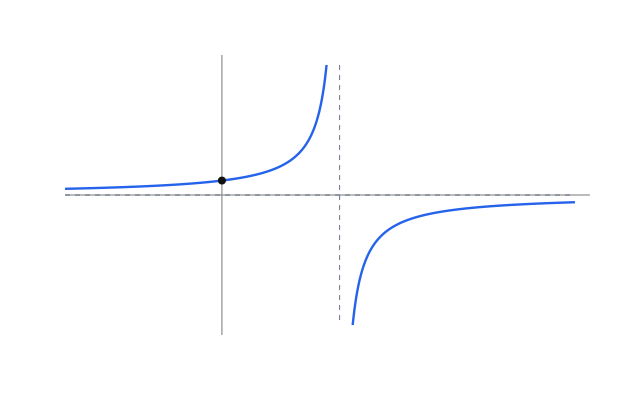
(i) .
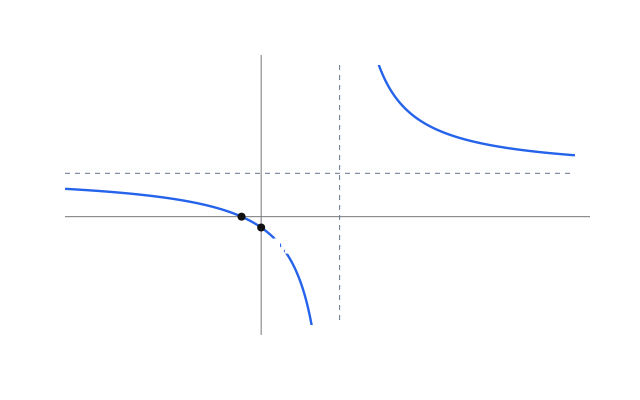
(ii) .
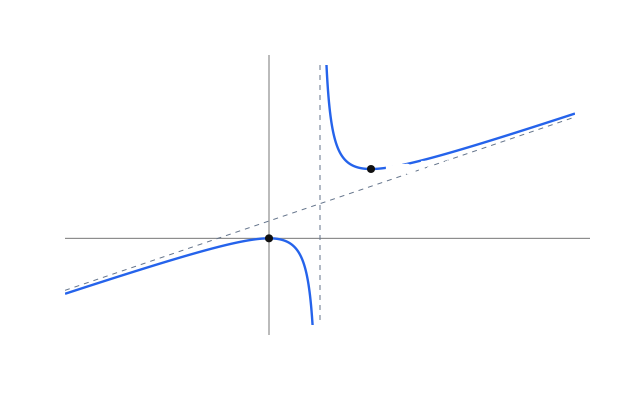
(iii) .
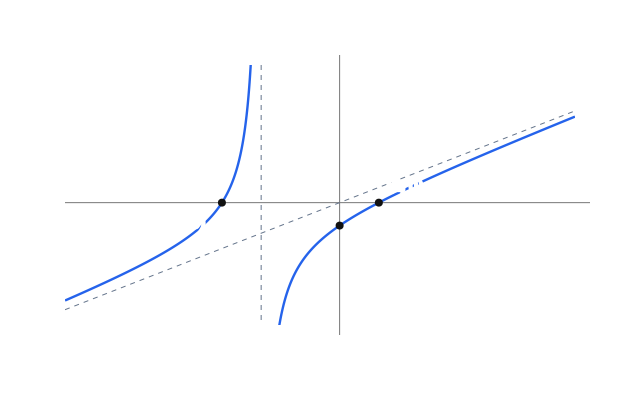
(iv) .
CJC · Lecture · Self-Practice 4
Answer
(i) Intercept ; asymptotes ; no stationary points. (ii) Intercepts ; asymptotes ; no stationary points. (iii) Intercept/local maximum ; local minimum ; asymptotes . (iv) Intercepts ; asymptotes ; no stationary points.
(i) Keep the negative reciprocal orientation
The source supplies the ask but no printed answer for this part. Independently , so is a genuine pole and is the horizontal asymptote. Substituting 0 gives , and the nonzero numerator gives no -intercept. Since on both branches, there are no stationary points. The left branch is positive and the right branch negative.
Expand diagramFit diagram to page
Use the scrollbars or arrow keys to inspect details.
(ii) Separate constant and remainder
No answer is printed for this part. Independent division gives
Thus the asymptotes are and . Intercepts are and . The derivative is negative on both branches, so there are no stationary points. The numerator at 2 is 5, so there is no removable cancellation.
Expand diagramFit diagram to page
Use the scrollbars or arrow keys to inspect details.
(iii) Check the two printed stationary points
Answer
Local maximum ; local minimum .
Both copies print Max.: ; Min.: . Independent working completes all requested features:
The denominator excludes 1 and its numerator there is 1: vertical asymptote , slant asymptote . The only axial intercept is ; its double zero gives contact. The derivative changes at 0 and at 2, verifying the printed local maximum and local minimum. They belong to different continuous branches and are not global extrema of the whole domain.
Expand diagramFit diagram to page
Use the scrollbars or arrow keys to inspect details.
(iv) Use the remainder to exclude stationary points
No answer is printed for this part. Independently
Asymptotes are and , with no cancellation at −2. Intercepts are . Since , neither branch has a stationary point.
Expand diagramFit diagram to page
Use the scrollbars or arrow keys to inspect details.
Common mistakes
Do not describe an extremum on one branch as the global maximum or minimum of a disconnected curve.
Solution notes
Student and Teacher PDF 23 are identical for this practice. Only the two turning-point coordinates for (iii) are printed answers. All other answers, derivations and plots here are independently authored and checked. No printed marks or external attribution.