Worked solution
Test cereal mass and invert a two-sided rejection
The mass, kg, of the contents of each packet in a random sample of 80 cereal packets is measured, with and .
(i) Test, at the 4% level of significance, whether the population mean mass of the contents is less than 1.10 kg.
(ii) In another test using the same data at 4%, states that the population mean is kg and states that it is not kg. Given that is rejected in favour of , find the set of possible values of .
[2003/II/29]
CJC · Lecture · Example 5
(i) Estimate the moments and set up the lower-tail test
kg and . Test against , with the population mean content mass. Under , use by the large-sample approximation. Individual normality is not given.
(i) Calculate p and conclude
gives . Reject : sufficient evidence at 4% that mean content mass is below 1.10 kg. The source prints variance 0.27088 and uses estimated SD 0.52046133381837 in Z-Test Stats with , , , lower alternative. Its screen shows and , printed as 0.034418. This source result is distinct from the full-precision calculation but gives the same decision.
(ii) Use both rejection tails
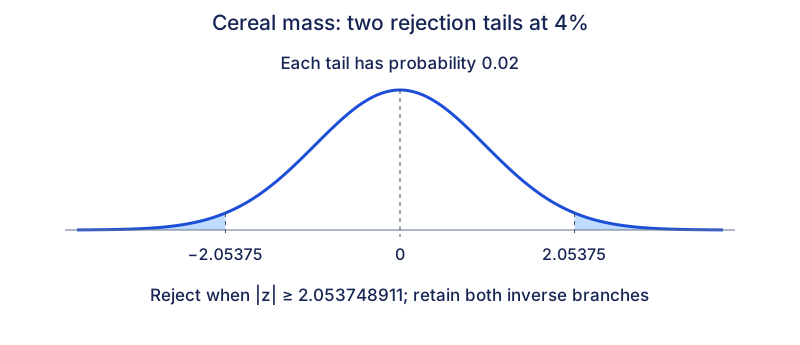
For against , the 4% test assigns 0.02 to each tail. With , reject when . The original PDF visibly includes the absolute-value bars, although extraction loses them. Equivalently, or .
(ii) Preserve exact boundaries and qualify the printed set
The full-precision boundaries are or . The source’s intermediate values are 0.87462 and 1.1136; its final real-valued set is or . Those final rounded endpoints admit some means that do not reject: for example, 1.11 is inside the non-rejection interval. Preserve the exact expressions for classification. The additional positive restriction reflects the mass context; intersect with if positive reference means are required. The teacher note also calls by and by ; these are alternate labels for the same roles, not different statistics.
Compare your sketch
Expand diagramFit diagram to page
Use the scrollbars or arrow keys to inspect details.
Common mistakes
The unknown μ₀ appears inside an absolute value. Solve both inequalities and keep full-precision endpoints; rounding can change membership of the set.
Solution notes
Teacher-completed estimates, model, p-value decision and both inverse inequalities integrated. Distinct yellow teacher notation note appears in the relevant inverse-test step. Source two-tail rejection sketch reconstructed independently. No printed marks.