Worked solution
Reverse a known-variance test for mean time and sample size
In a factory, the time in minutes for an employee to install an electronics component is a normally distributed continuous random variable , with standard deviation 5.0 and ordinary expected value 38.0. After background music is introduced, a sample of components is taken and the mean time for randomly chosen employees is minutes. A test at 5% determines whether the population mean installation time has been reduced.
(i) State appropriate hypotheses, defining any symbols.
(ii) Given , state the set of values of for which the test rejects .
(iii) Suppose instead that and is not rejected. Obtain an inequality involving and find the set of values that can take.
[2011/II/10]
CJC · Lecture · Example 6
(i) Define the parameter and hypotheses
Let be the population mean installation time in minutes after music is introduced. Test against . The known standard deviation remains 5.0 minutes. Under , and exactly for independent normal sampling.
(ii) Translate the critical value into a mean boundary
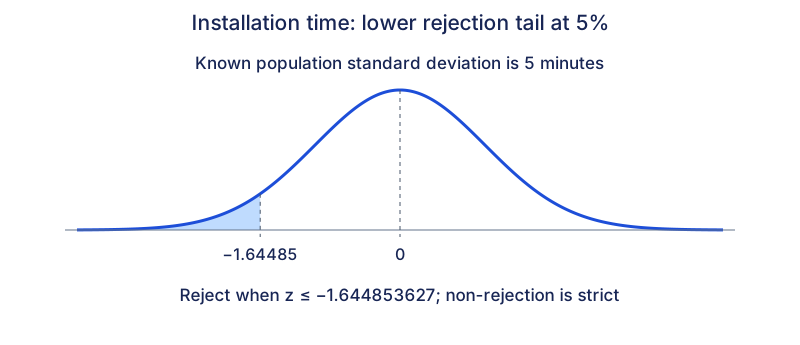
At 5%, the lower critical value is . For , reject when . Thus minutes. In the positive-time context this gives . The source gives after rounding; 36.8 is a boundary label, not the exact rejection set for real-valued means.
(iii) Use strict non-rejection before squaring
With , the observed statistic is . Since rejection includes equality, non-rejection means , hence and . As is a positive integer, . The source uses rounded , , and the same integer set. Here normality and known variance justify the test even for small n; do not impose an unnecessary n≥30 restriction.
Compare your sketch
Expand diagramFit diagram to page
Use the scrollbars or arrow keys to inspect details.
Common mistakes
Do not reverse the strict non-rejection inequality. The sample size is an integer; the sample mean is not stated to lie on a rounding grid.
Solution notes
Teacher-filled hypotheses, null distributions, critical rule, mean inequality and integer-size solution integrated in the matching steps. Original source lower rejection sketch reconstructed. No printed marks.