Worked solution
Check a repeated root and include isolated equality solutions
Solve (i) and (ii) .
CJC · Lecture · Example 2
Graphical method: read crossings and a touch
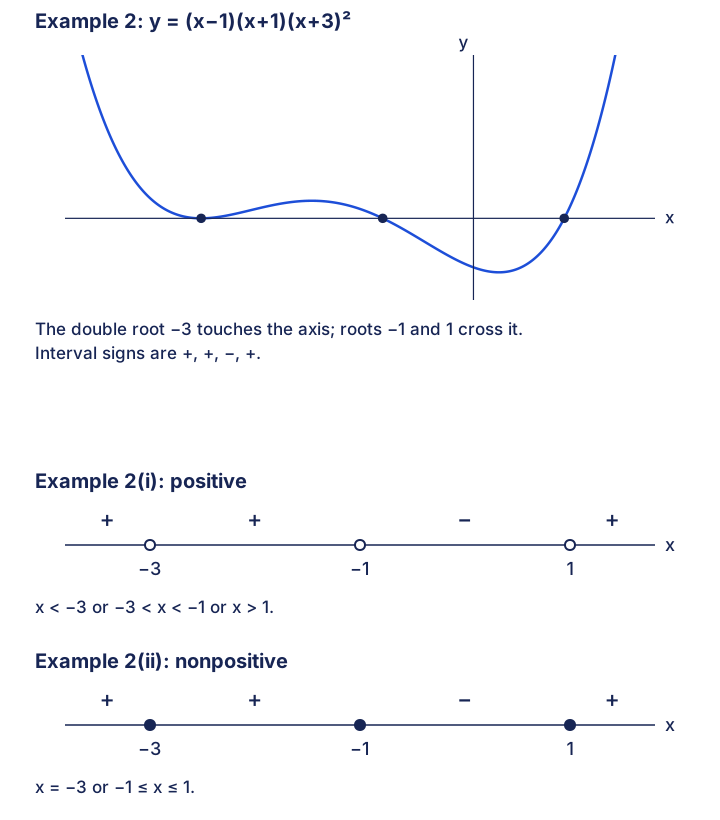
The polynomial has roots −3,−1,1. At −3 the squared factor makes the graph touch the axis without changing sign; the other two roots cross. The sketch is positive on the two intervals left of −1 except at −3, negative between −1 and 1, and positive beyond 1.
Algebraic method: retain both endpoint conventions
Test signs on : +,+,−,+. For (i), exclude all zeros: x<−3 or −3<x<−1 or x>1. For (ii), include the zeros as well as the negative interval: x=−3 or −1≤x≤1.
Apply the source remarks
For ≥ or ≤, check every critical value carefully. Do not assume signs always alternate: a repeated root with even multiplicity preserves the sign, as at −3. The source contrasts this with Example 1’s simple roots; more generally odd multiplicity changes sign and even multiplicity does not.
Compare your sketch
Expand diagramFit diagram to page
Use the scrollbars or arrow keys to inspect details.
Common mistakes
For the nonpositive inequality, −3 is a valid isolated point even though both neighbouring intervals are positive.