Worked solution
Keep a denominator zero separate from allowed endpoints
Without using a calculator, solve .
CJC · Lecture · Example 4
Make one rational expression
gives , hence . The domain excludes x=0.
Test signs and distinguish zeros from undefined inputs
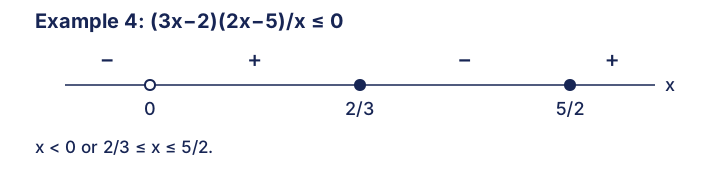
Mark critical values 0,2/3,5/2. The interval signs are −,+,−,+. Choose negative intervals and valid zeros: x<0 or 2/3≤x≤5/2. The numerator zeros are included because the inequality is non-strict; the denominator zero is always excluded.
Answer the source cross-multiplication prompt
The speech bubble asks whether x can simply be removed by cross-multiplying. The source remark explains that x may be positive or negative: multiplication by a positive x preserves the sign, while multiplication by a negative x reverses it. A sign diagram handles both cases together without silently dropping the negative-x solutions.
Compare your sketch
Expand diagramFit diagram to page
Use the scrollbars or arrow keys to inspect details.
Common mistakes
Never include x=0. Multiplying by an expression of unknown sign requires separate sign cases.