Worked solution
Prove a quadratic is positive before removing it
For real x, prove is always positive. Solve , leaving the answer in exact form.
[2013/NJC/I/2(part)]
CJC · Lecture · Example 5
Positivity method 1: complete the square
, proving positivity for every real x.
How did this part go?
Positivity method 2: use the discriminant
The discriminant is , and the coefficient of x² is positive. The upward-opening quadratic never meets the axis, so it is always positive.
How did this part go?
Combine the fractions
Move the right side to the left: . The common numerator is , so require , with x≠0.
How did this part go?
Remove only the positive factor and read signs
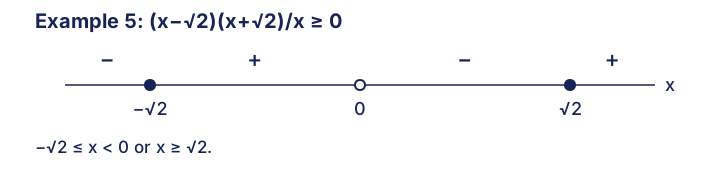
Since the quadratic is strictly positive, this is equivalent to , or . Mark −√2,0,√2; interval signs are −,+,−,+. Hence or . Keep the numerator zeros and exclude the pole 0.
How did this part go?
Compare your sketch
Expand diagramFit diagram to page
Use the scrollbars or arrow keys to inspect details.
Common mistakes
It is safe to remove 2 x²−x+2 only after proving its sign. The remaining factor x still changes sign.