Worked solution
Use either a difference graph or a denominator sign test
Find the set of values of x satisfying .
CJC · Lecture · Example 6
Method 1: graph one difference
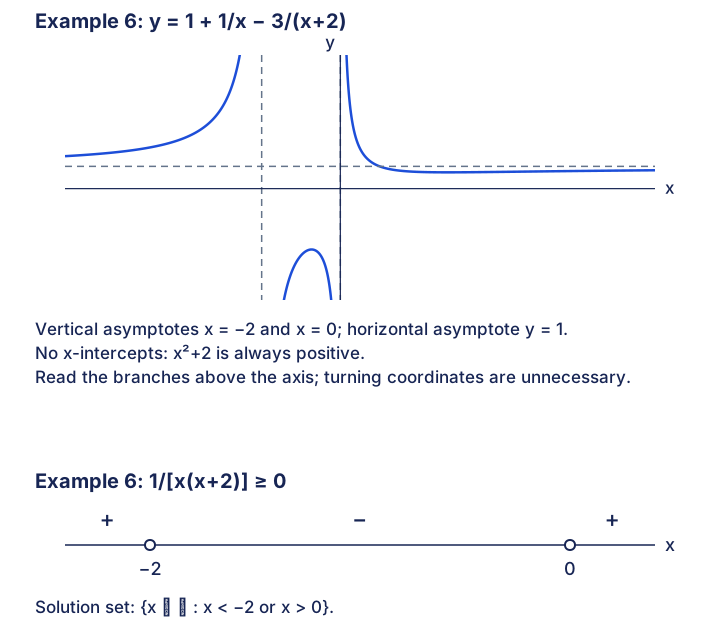
Bring the right side to the left: . Sketch . It has vertical asymptotes x=−2 and x=0, horizontal asymptote y=1 and no x-intercepts. The first and third branches are positive; the middle branch is negative. Thus . To decide this inequality, focus on the branch signs and poles; turning-point coordinates are not needed.
How did this part go?
Method 2: reduce to a sign test
The left side is . Since x²+2>0 for every real x, require . Signs around −2,0 are +,−,+. The solution set is . Neither pole is allowed, and equality never occurs because the numerator is positive.
How did this part go?
Compare your sketch
Expand diagramFit diagram to page
Use the scrollbars or arrow keys to inspect details.
Common mistakes
The ≥ sign does not make an undefined denominator value admissible.