Worked solution
Check the radical domain before reading or squaring the inequality
Solve .
CJC · Lecture · Example 7
Start with the real domain
The square root requires 16−x²≥0, so −4≤x≤4. The right side is nonnegative; any solution of the strict comparison must also have x>0.
Method 1: graph the difference
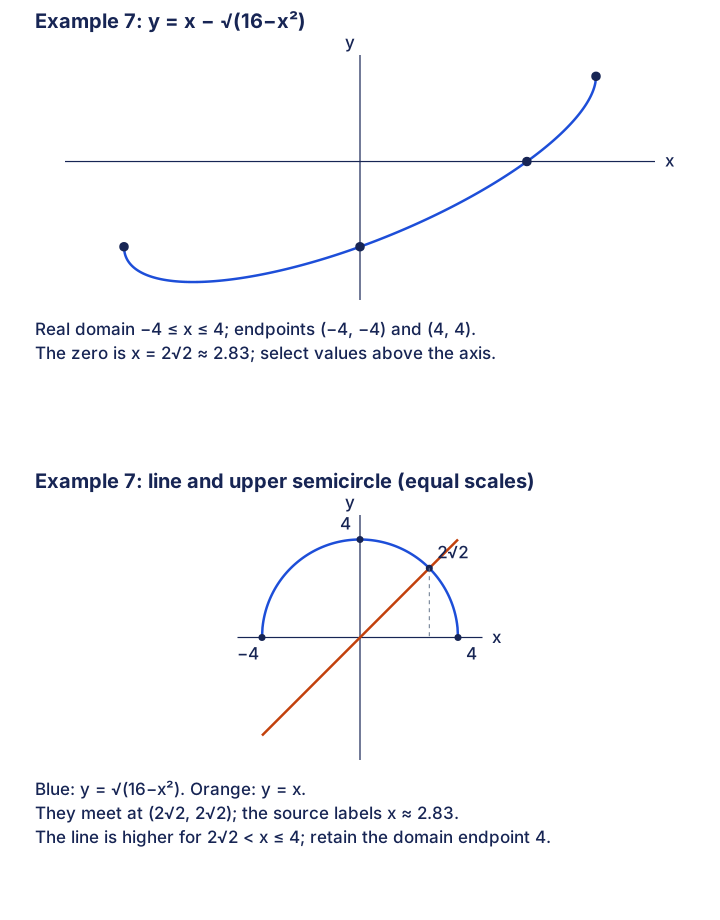
Sketch on its real domain. Its endpoints are (−4,−4) and (4,4), with y-intercept −4. The source labels its zero x≈2.83 and reads 2.83<x≤4. This is a rounded graphical boundary; the exact zero is 2√2, giving .
Method 2: compare the line and the semicircle
Sketch y=x and , the upper semicircle of radius 4. The source labels height 4, endpoints (−4,0),(4,0), and the intersection input≈2.83. Select the line above the semicircle, retaining the allowed right endpoint: . The left endpoint is not a solution.
Analytical check: square only after the sign and domain checks
Because x>0 and the radical is nonnegative, squaring is equivalent here: , so x²>8. Combine the positive-input condition with −4≤x≤4 to obtain . The strict crossing is excluded, but x=4 gives 4>0 and is included.
Compare your sketch
Expand diagramFit diagram to page
Use the scrollbars or arrow keys to inspect details.
Common mistakes
Squaring without x>0 would falsely admit negative inputs. Keep x≤4 from the radical domain, and do not treat 2.83 as an exact strict endpoint.
Solution notes
The source’s 2.83 is a rounded crossing; the exact lower boundary is 2√2.